111. Massimo Barbolini: What you won yesterday doesn't count today.
Massimo Barbolini is a women’s volleyball icon: a decades-long winner with top Serie A clubs and national teams. He recently worked in the U.S. with LOVB, and was part of Julio Velasco’s Olympic gold medal winning staff.
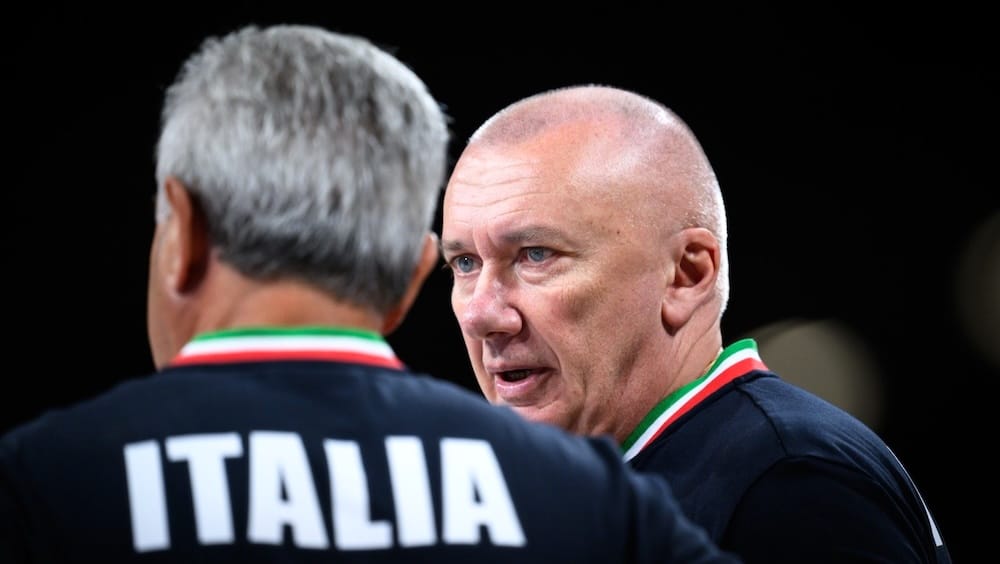
For nearly forty years, Massimo Barbolini has worked at the highest level — from the golden years of Italian club volleyball to today’s global professional game. He won in Serie A with Matera and built a dynasty at Sirio Perugia, collecting league titles, national cups and the CEV Champions League, then continued to deliver results with big-name clubs such as Pesaro, Casalmaggiore, Novara and Scandicci.
Massimo’s national-team accomplishments alone put him in rare company. As head coach of Italy’s women, he carried them from contender status to reference point in the women’s game: European champions in 2007 and 2009, plus FIVB World Cup titles in 2007 and 2011.
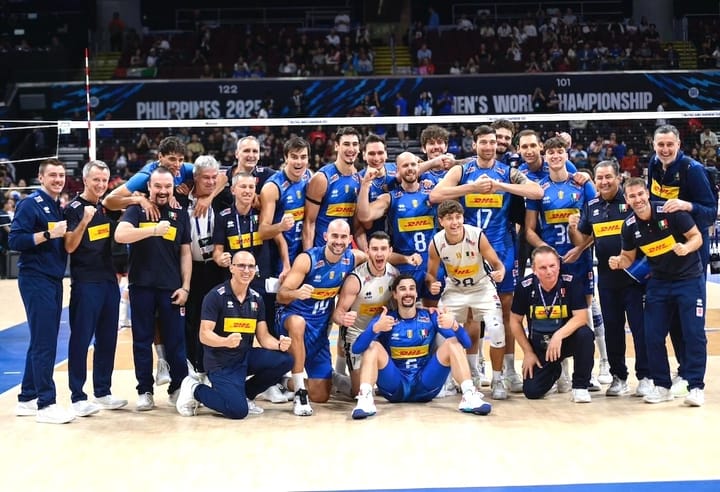
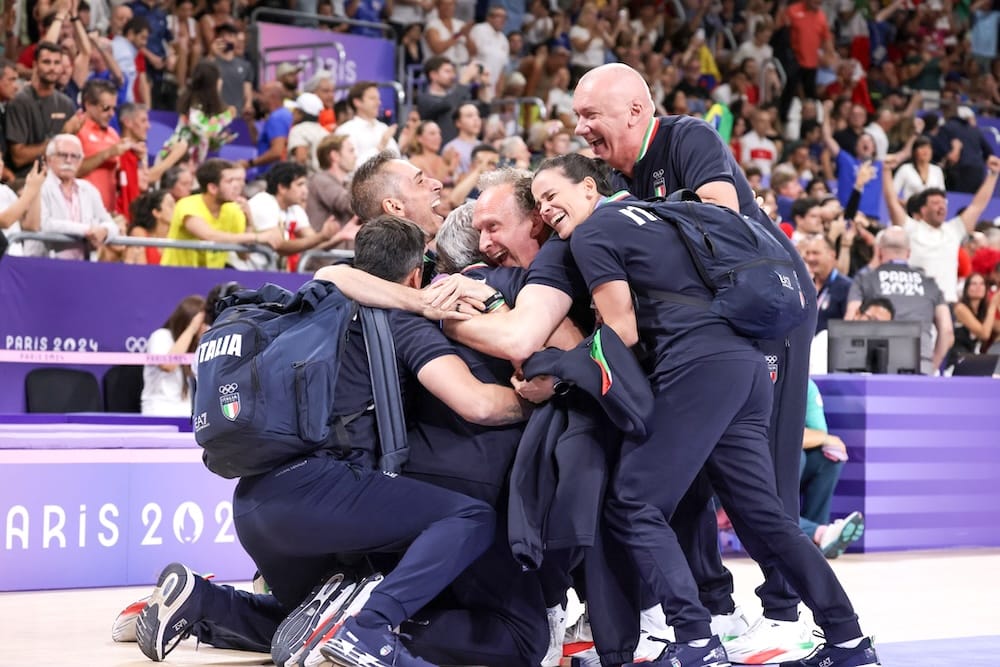
When Julio Velasco took over Italy again, he brought coach Barbolini onto the bench as an assistant—part of the staff that went on to win Olympic gold in Paris 2024, and the 2025 VNL and World Championships.
Massimo has also contributed to the growth of the professional game in the United States with LOVB Houston.
Wherever he’s worked, the pattern is the same: clearer standards, better systems, and teams that end up competing for titles.
Key takeaways from this article include:
- The "sliding doors" moments that shaped his career, from Julio Velasco's mentorship to getting fired in Spoleto very early in his career
- Why coaches who need to show they're in charge aren't really in charge
- Why he believes in creativity and problem-solving within a system of a few rules
- The art of saying less: reducing video sessions, match preparation, and information to the absolute minimum
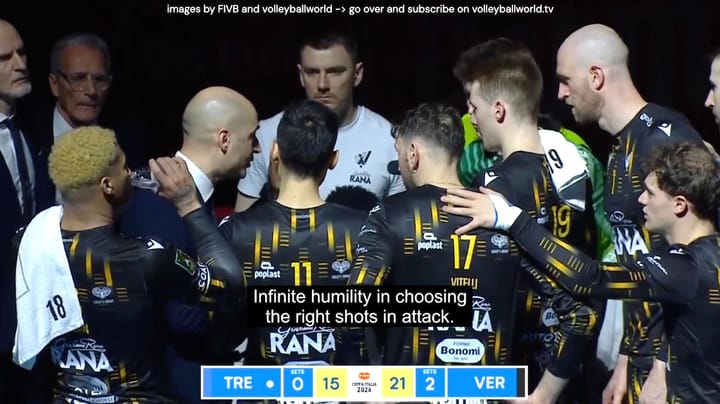
- Why he never enters the locker room before a match, and his admiration for coaches who can deliver value there
- Putting your medals in a drawer: the discipline of erasing what you've done and starting fresh
- His obsession with high balls in the transition game and why he'll never believe in speed for speed's sake
- How social media is making the coach's job harder, and why clubs should care
- The tactical trends he refuses to follow and the rule changes he believes the game needs
- And so much more...
We have over 1 hour of edited conversation with coach Barbolini in this article. Enjoy!
Enter Massimo...
Matias Raymaekers: Why did you decide to commit to being a professional volleyball coach? What pushed you towards that decision?
Massimo Barbolini: It's been a long time now, a really long time. But I remember the reasons well. Basically, I was playing at Panini Modena. I was pretty good, actually. I was captain of the under-16, under-17 teams.
But then I had a shoulder injury and had to stop playing. So I started coaching a bit in the youth system.
Then, luckily, when I was twenty-one, Julio Velasco arrived as head coach. He wanted a young assistant coach from the youth system. And at that time, people were starting to think about trying to make coaching a real profession, mind you I'm talking about the 80's here.
Because back then, almost all coaches were phys-ed teachers who did coaching on the side. So, following Julio's advice, I said let's give it a shot. I'll keep studying, obviously, but I'll also try to be a coach.
The lucky thing was that when he left to coach the national team, I was twenty-five, and Agrigento called me right away to be head coach in A2. Almost all of my players were older than me. I had Zaytsev as setter, just to give you an idea. And from that point on, the fulltime profession of coaching also started to emerge.
Things went pretty smooth for me, it was one of those sliding doors moments where you step through and you're in.
If I think back to the beginning, there are so many episodes that make me think yes, I definitely earned it, but I was also quite lucky.
Because there are so many times where now I see coaches starting out and all it takes is one bad season, or even half a bad season, and boom, it's all over.
I was fortunate to get pretty good results from the start. But speaking of sliding doors and strange situations, after four years I had the only firing of my entire career, when I was in Spoleto.
And from there I was lucky enough to be called to coach the women's team in Matera, which was one of the top teams in Europe. That's where my career in women's volleyball began. So maybe if they hadn't fired me from Spoleto, I would have done another half season, maybe some good and bad seasons, but I might never have gotten that opportunity. An opportunity that yes, I earned, but you also need a bit of luck. That's what I believe.
But if I think about the key moment, I remember it perfectly. Talking with Julio we'd say, I'm young, there's no family yet, so why not try? Why not try doing this full-time? Back then it was a really unusual thing. Even financially. I mean, sure, things now are definitely worse than they were years ago at the beginning.
Because now there are coaches where, if I'm being honest, I'd have to advise them, if you have a family, yeah okay, coach, sure. But first find a job. Then coach on the side.
One more thing I'll say, something I'm also quite proud of, is having managed to do all of this while still, as much as possible, being there for my family.
I know it's not easy. But I managed to raise a family. It's something I'm proud of, having managed not to let one thing negatively affect the other. That's something I really value.
Maybe my wife sees it differently, that I'm never home. And my daughters too.
But no, joking aside, I'm happy to have been able to do both things up to this point.
Matias Raymaekers: What advice would you give yourself as a starting coach? An advice that is so clear and logic for you now, but that you had to develop over the years.
Massimo Barbolini: Well, my advice would be what I think I've done myself. Meaning, always be humble.
Don't try to force yourself to do things just because you see others doing them, because everyone has their own character, their own personality. I mean, I went to Agrigento at twenty-five. I couldn't behave the way Julio Velasco behaved at Panini, even though he was my role model.
I was talking to players who were almost all older than me. So sure, certain lessons applied, but I think the way you carry yourself also has to be different.
I think, and I hope, that I've still managed to maintain that balance. Sometimes I criticize myself because maybe it's a bit too much, too humble at times, maybe I should assert myself a little more in certain situations. But I think that approach has been important.
Because I see a lot of young coaches whose first priority is showing that they're the ones in charge. The first thing they want to prove is that they command respect. They don't accept dialogue. And I think that's wrong. Also because, honestly, I haven't seen those coaches go very far.
That doesn't mean you should always give in to certain situations or just accept whatever people want. No. But wanting to show from the start that you're the boss, that actually means you're not really in charge.
When someone constantly needs to show who's in charge, to remind people what they've won, to say "do you know who I am?" To me, that's a big sign of insecurity.
And I'm sure you, as a high-level player, you must have noticed this too. Players pick up on it. Players absolutely pick up on it. Because when a coach has too much need to show off, too much need to prove himself, it means he's not really confident in himself or in what he does.
Matias Raymaekers: What has changed in coaching over the years? Things to look out for that can sidetrack you if you're not careful about it.
Massimo Barbolini: In my opinion, coaching is a very difficult job. I'm very happy. I'm past sixty now, so I'm just grateful. I hope I can keep going as long as possible because I enjoy it.
I enjoy it, maybe because they're really all younger than my daughters now. But it makes me feel young every time I walk into the gym. It keeps me feeling young, so I wouldn't change a thing.
What I do see, and it bothers me a little, though honestly I'm getting to the point where I just don't care anymore, is that what has changed for the worse is the impact of social media on volleyball. It didn't exist before. Even twenty years ago, it wasn't there. And probably my generation has a harder time accepting it.
What I think we need to realize, and it's hard to realize, is that clubs get influenced by this. In the sense that in the end, people can write whatever they want about me. I removed my access to Instagram. The only reason I had it was to share photos with my daughters and photos of my dog. But since people started writing insults under the photos of my kids, under the photos of my dog, I made my account private.
But only for that reason. Not because of the criticism. They can criticize me from anywhere and I couldn't care less.
But what I see is that there are situations where you can tell that clubs are being influenced by this stuff. And that makes the coach's job even harder. You're already alone against everyone. You're already the first one on the list when things go wrong.
If on top of that, from the outside, people give weight to these things, it really makes our job incredibly difficult. I always tell setters, look, you're second in line. First it's us coaches, and then it's you setters. And if the setter is a foreign player, it's even worse. But we're always there, always right at the top. That's something I honestly accept, completely, because I know it's part of my job.
But I think clubs in general should do a bit more to defend the figure of the coach. Because in the end, yes, maybe you're the one who loses out because they fire you. But ultimately everyone loses. I've always believed that. If you're a club and you have a coach, it's like a coach with a player. You might think he's not the best, but in that moment, he has to be the best. Because if I as a coach show that I don't trust the setter, it's over. If the club shows it doesn't trust the coach, it's over.
People always focus on what hits them personally. Maybe there are twenty negative comments and a hundred positive ones, and you look at those twenty. Or one negative and ten positive, and you focus on that one.
But again, what I'm saying is, if the club listens to that stuff, it's their problem. Because in the end, they're the ones paying, they're the ones losing the chance to win. Then the blame falls on the coach. Fine, the blame will always fall on the coach. But in the end, you still didn't win.
Because unfortunately, and this isn't just in sport, it's in society too, we have this tendency to always need to figure out whose fault it is. I see people who focus first on making sure that if something doesn't work out, it's not their fault. They don't put their energy into making it work. But if it goes wrong, they're like, it wasn't me, it was this, it was that.
That's maybe why, if we're coaches or players who are used to taking responsibility, that actually helps us get good results in the end.
Because in the first place you have to focus on getting the result. Not on justifying why the result didn't come.
I think that's a concept I carry very strongly in my head. And I see that the more time goes on, partly because of this whole social media thing, players are being bombarded too. They're used to being judged. And not just in sport, in life too.
Kids at school are constantly being judged or scored. So you always have to think about justifying yourself. You're always on the defensive. If you can't do something, you're stupid.
No, if you can't do something, you just can't do it yet.
I'll tell you, I'm not really someone who follows speeches and talks and that kind of stuff. But there's one that I definitely like a lot. The Federer one, where he explains how many points he won and lost, and it's basically fifty-fifty. I send that to my young players wherever I go. Every single time. It's not Massimo saying this. It's Roger Federer, the greatest tennis player of all time. He's the one saying it.
So think about that. And if you make a mistake every now and then, that's fine. It happens.
54%
Matias Raymaekers: Big question, really big question. Your connection with Julio is a special one, so this question brings me to a lack of judgement I had when doing a video call with him. After that one time, I never did that again. :-)
I asked him if he'd already achieved everything he wanted to achieve in volleyball. This was right before he started coaching at Busto, and he said, are you kidding? I want to coach women's volleyball, do the national team, and win there. The results are here now, so that question will never again be asked in that same way. 😄
So the question to you is, what's the goal that makes you get up in the morning? Do you (still) have one?
Massimo Barbolini: I have one. In the sense that for me the goal is always to try to get results, to try to win. Obviously sometimes you're in situations where it's really hard, really hard to think about winning.
But that goal, which I think transforms into "trying to win", is really about having respect for your own work.
Like I said, for almost forty years I've been making sacrifices and my family has been making the sacrifice of being away from me. So yes, money is important. But money alone doesn't make you get up every day wanting to go to the gym. And honestly, there are days when I don't feel like it either. But I have to go because it's my job.