122. Andrea Pistola: Not everyone can be the best in the world, but everyone can be their best version.
From youth volleyball in Falconara to a European trophy in Athens. The Vallefoglia coach on why he chooses growth over results, how he prepares a team day by day, and what changed when he stopped carrying losses home.
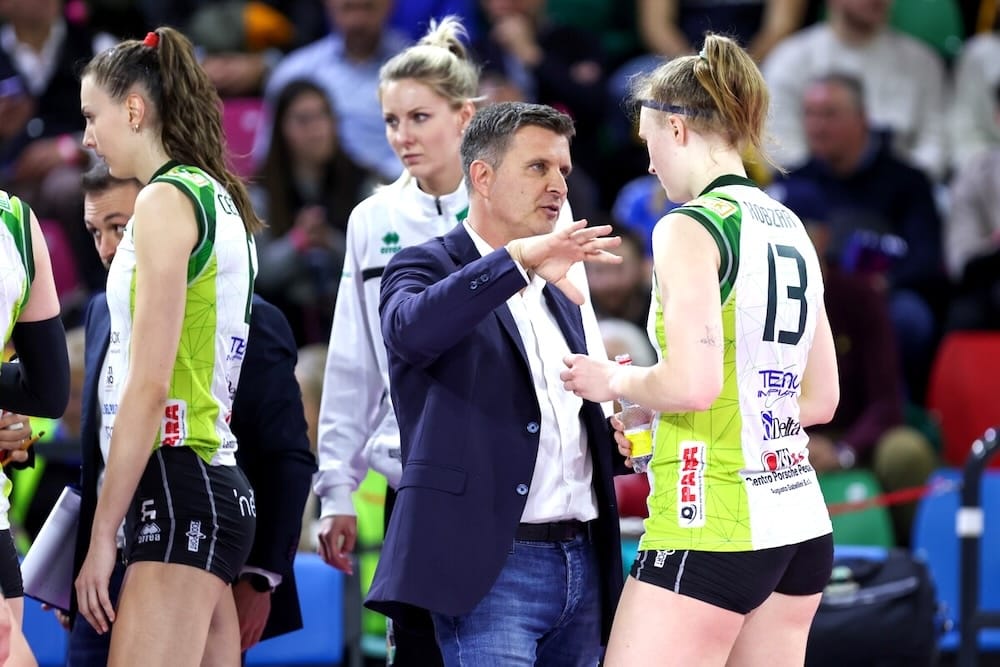
Andrea Pistola has spent close to twenty seasons in the Italian Serie A1 and A2, building something that might be harder than winning with a powerhouse: taking clubs without a big history and turning them into teams that make the playoffs, year after year.
At Cuneo, he arrived midseason in 2018, led the club to promotion to A1 and kept them in the playoff picture. At Vallefoglia, a club that had never played a playoff game, he reached the playoffs in his very first season. In his second came the club's first Coppa Italia quarterfinal and a ticket to Europe. In his third, in March 2026, he won the CEV Challenge Cup in Athens, the first international trophy in the club's history.
His path to get there was anything but direct. Three herniated discs ended his playing career at 20. A phone call from a former coach brought him into the gym with a youth girls' team in Falconara, and he never left.
Andrea's gym is a place where players grow, and many of them stay or come back. Gaia Giovannini developed with him as a teenager at Cuneo. Today she plays for him again at Vallefoglia, but now as an Olympic champion. Next to her are fellow Olympic champion Loveth Omoruyi and American Alexandra Frantti, who first played for him at Casalmaggiore.
Earlier in his career, he coached Olympic champions Annie Drews and Carlotta Cambi, and US national team setter Lauren Carlini.
In this conversation, held in Italian and translated into English, we talk about:
- The one quality he believes separates good coaches from the rest
- How he builds a shared work mentality in the first weeks of a season, even when half the roster has not arrived yet
- Why Conegliano proves that technique still beats pure physicality, and what youth volleyball is getting wrong
- A full match week, day by day, from video sessions to individual scouting
- His dream six, built from the players he faces every week
- The season that ended with him being let go, and how it changed the way he handles setbacks
- How he went from carrying a loss home for days to switching to solutions within half an hour
- Why not everyone can become the best in the world, and what every player can become instead
Enjoy the conversation.
Matias: Andrea, you didn’t plan on becoming a coach. How did it start, and what shaped you in those early years?
Andrea: Yes, I was kind of forced into it. I started out as a player. My playing career wasn’t at the very highest level, I got as far as Serie B in Italy. But at 20 I had serious back problems. I had three herniated discs, and they forced me to stop completely. That was the early 90s, and back then it wasn’t easy to go through rehab for a problem like that. So I had to give up what had been my passion, volleyball.
I remember that around that time a friend of mine, who had also been one of my coaches, called me and asked me to help him with a group of young girls who played in Falconara. At first I wasn’t really convinced it was what I wanted to do.
But after the first five or six practices, I saw that I could pass on the passion I had as a player and put it to use for someone else.
That gave me a big push. I started to realize that maybe this was something I enjoyed doing. At the same time I was studying sport science here in Italy, in Urbino, so my path was heading toward sport and teaching sport anyway.
From there I went through a very long process of working my way up. I consider myself lucky that I wasn’t one of those coaches who started out right away on a professional path. I spent 10 or 15 years paying my dues, starting with youth leagues, always in women’s volleyball of course, with very young girls, all the way up to the regional leagues and Serie B. Then I made it to the professional world around 2002, 2003, and it continued from there.
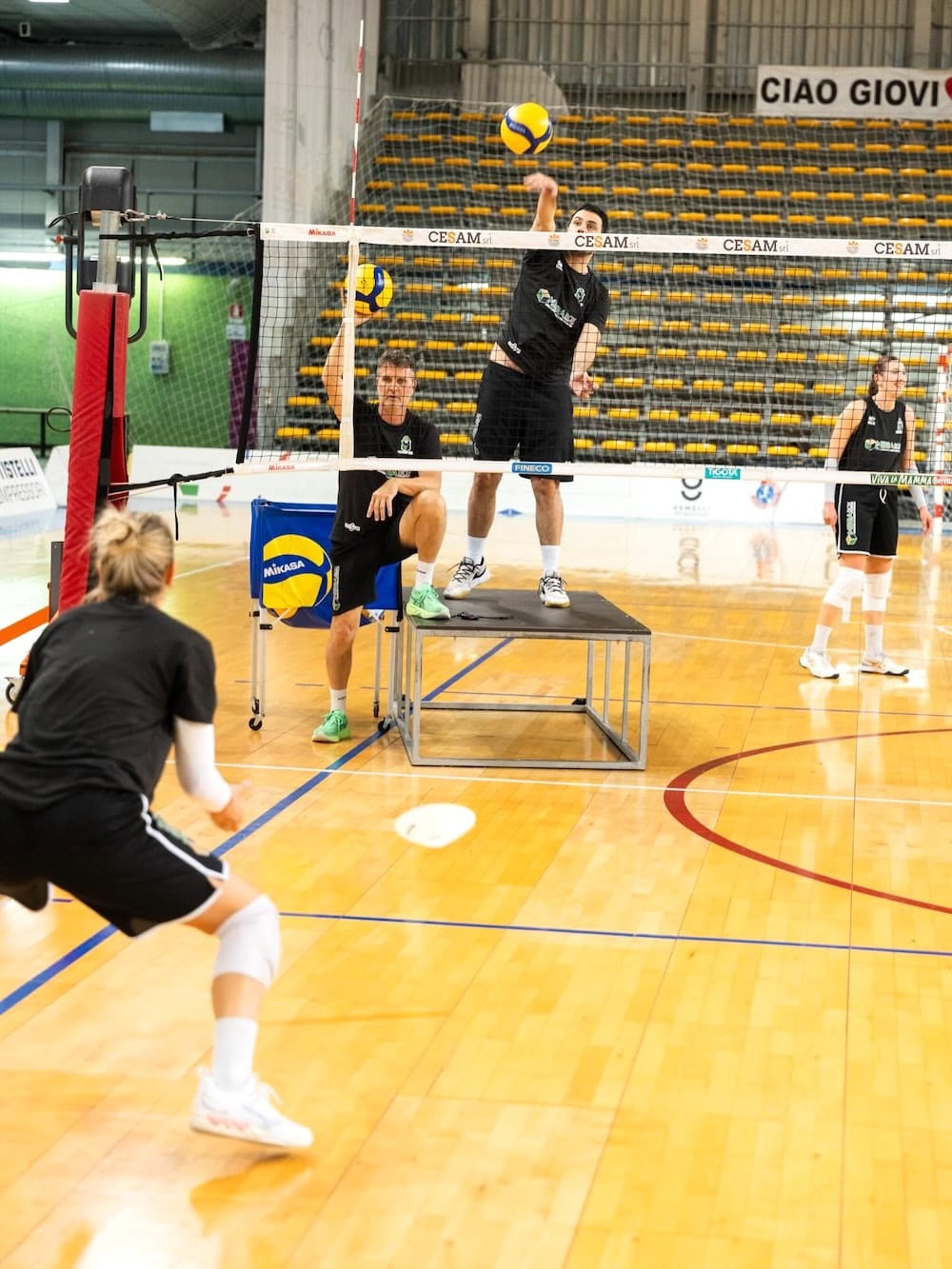
Financially it wasn’t easy to support myself just by coaching. So I also worked as a strength and conditioning coach. With my sport science background, plus some advanced courses I took, I could keep working as a personal trainer too. So I kept going on two parallel paths, volleyball and physical conditioning.
I have to say this helped me a lot. It gave me the chance to slowly refine a training system, with workloads suited to different levels of players. Today, when I work with the conditioning coaches on my teams, I’m able to manage the workload much better. Going through that long process of working my way up was a real stroke of luck. It made me better technically and in my training methods, which I kept refining bit by bit. It also meant that until 2005, 2006, I was both the conditioning coach and the head coach on the same team. That helped me get this part right, and managing the training volume is often a very delicate thing. Having some knowledge about it made things a lot easier for me, I have to say.
Matias: If you could go back and talk to the young Andrea who was just starting out, what would you tell him?
Andrea: For sure, with many years of experience you learn to handle the managerial side of the coach’s role much better. That means managing your relationships with the players, with the clubs, with the staff. These are things that at the start, either from lack of experience or lack of knowledge, you find harder to do.
But I think it’s right to have made mistakes. It’s right to have gone through a path where you had to try things out on yourself and find out what didn’t work. That becomes a background you carry with you for your whole career. So I don’t like the idea of telling the Andrea of the past, do this already and you’re ready.
In my opinion, trying things out on yourself and learning from experience is a big added value.
I see the same thing on a personal level. I think that, as a person too, a 25 year old can’t do the same things a 50 year old does. So it’s right that there are stages where you try things out and learn them firsthand.
Matias: What do you think separates a good coach from the rest?
Andrea: I’m very convinced that a coach’s quality lies mainly in knowing how to recognize the problem and knowing how to find the right solutions for that problem. The methods people use are obviously very personal. Some have one kind of approach, others have another, and some believe more in certain concepts.
Let me give you an example. When I started my career, volleyball was much less physical. So, especially in the women's game, some skills were given more importance than others. Now, obviously, some things have to be adjusted as the type of game changes.
So yes, if you see a coach who spends eight hours a week doing only defense and doesn’t work on blocking and attacking, in modern volleyball I’d say he’s doing something that isn’t right. The same goes for a coach who builds reception work mainly around a forearm pass in front of the body. At the moment, with the speed of the serve, a strong passer has to be able to receive at pretty much every angle. So I’d say that coach may be doing work that doesn’t fit the kind of game that’s developing.
But I repeat, in my opinion a lot depends on how you present things, how you get them across to the team and to the individual players. That’s where I think the real secret lies for a coach.
Matias: What drives you as a coach? What are you really after, season after season?
Andrea: The goal I’ve always set myself has never been tied first and foremost to particular career or sporting goals. Obviously everyone likes getting results and being a protagonist in great seasons. But what really motivates me every season is having the chance to work with groups where I can do a certain kind of work, focused on growth and not only on management.
Honestly, that’s the part I like a little less, just having to go into the gym to manage the people I have and get them ready for a match. What I like much more is being able to make a difference in the path of a player, an athlete or a team.
Andrea's Cuneo pushes Novara to game three of the 2022 playoff quarterfinals, in a season that matched Cuneo's best ever A1 finish.
When I choose players, the first thing I look for is always people who are really motivated, who want to put themselves on the line and try to change something. Because that’s the part that has fascinated me most, teaching technique and seeing not only the result on the court, but also the result of the individual athlete who, by the end of the season, has improved at what she does. That gives me a lot of satisfaction, a lot of fulfillment.
And I would never trade it just for the idea of going to a team that can get results and has bigger ambitions. I love doing this job, and I do it with this conviction. I like doing it this way. If I had to do it differently, I probably wouldn’t be myself, and I wouldn’t do it well either.
Matias: When you start a new season with a team, what do you focus on first?
Andrea: Let's say that these days everything is always very complicated, so I'll give you an answer about how I would like it to be. At this level the team very often comes together along the way. You might start the season without even half the roster. So building concepts and a work mentality is a bit more complicated, because you always have to bring someone in along the way.
But in an ideal situation, where I have a team built from scratch with a lot of changes, the first part of the season is definitely the most important. It's about making clear right away how I want the work to be done, how I want my team to play, and what mentality I want them to bring to the season and to each match.
Beyond the technical side, of course, it's an evolution that depends on the training loads and on the gradual build up that's needed, because some athletes may have done very little and others a bit more. But what I care about is creating a work mentality that is the same across the whole team, and bringing all the girls to have that kind of approach to training, and to the professionalism with which they prepare everything.
So it's an important aspect, because that base then allows you to keep building throughout the year. If you don't create a group that is united in the way it approaches the work, there's a risk that at the first difficulties everything gets lost along the way.
The last day of Andrea's first season at Vallefoglia: a 3 to 0 win over Egonu's Milano and the first playoffs in club history.
And not only by working on the mental side, but through the practice itself.
By demanding in practice that kind of commitment, consistency, willingness to put yourself on the line, and courage in doing things.
What I don't like in a team is having players who don't know how to put themselves on the line, players who don't have the desire to try new things.
I'm a coach who always starts a lot from dialogue with the girls. So before changing something they've already consolidated, I always try to understand first whether they really feel the need to make a change. But I like people who are open to changing what they already do, if they can, or if they see a chance to improve it.
Matias: That's already a good starting point. If they really don't understand it, don't see it and don't feel the need, it already becomes very difficult.
Andrea: Yes, because in the end I've been lucky to work with athletes who already had a very important career behind them. In my opinion, even an athlete who is already very developed has room to change, even if it's only small details. And if you end up with players who don't have that kind of drive, in my opinion that isn't right for the project I'm working on.
Matias: Volleyball keeps getting more physical. How do you see the balance between physical and technical qualities in today's game?
Andrea: There's no doubt that the way volleyball is evolving is much more geared toward physical selection and much less toward technical selection. But I take as a reference the most important models of play we have in our sport. Take Conegliano, for example, who have won more than 30 titles in the last ten years, maybe even in less than ten years.
It's true that it's a team with remarkable physicality, but it also has impressive technical quality. The first touch quality of players like Gabi or De Gennaro, or the setting of Wołosz, is what really makes the difference, along with the attacking quality of the individual athletes, of course. So what I think isn't right is focusing only on the physical side, because in the end, in the long run, it's the players with strong technique who make the difference.
So I would like us to go back to working a bit more on the technical side, especially in youth volleyball, because I think it has been, I wouldn't say neglected, but pushed into the background.
I see a lot of girls reaching Serie A1 in Italy with clearly weaker technical qualities compared to when I started, about twenty years ago.
In the early 2000s, to get to A1 you had to have almost excellent skills in everything, on top of being physically gifted. Now I see much more physical quality. A lot of players jump higher and are more powerful, but players with a very, very limited technical toolkit are also reaching this level.
And in the end, in my opinion, the quality of the game pays a bit of a price for this. In fact, when you face teams with strong technical qualities, the gap becomes huge.
Matias: The rules have become more permissive over the years. How has that affected the technical quality of the game?
Andrea: In my opinion we went down a path where we tried to liberalize a bit of everything, thinking it would make the game more spectacular. So any kind of touch was allowed in reception, then setting could be done in any way without risking a fault. And then we also moved to attacking shots that were not...
Matias: They weren't really attacks anymore, yes.
Andrea: They were more like shots and pushes, they weren't attacks anymore. They were things that were unimaginable a few years earlier. Now we've taken a small step back, trying to clean up at least the attacking motion, so that it's a bit more technical.
In my opinion it would definitely be an advantage to bring the first two touches back to a higher standard of quality too. That means being a bit less permissive, both on the set and on reception. I understand that in the men's game, for example, with the ball traveling so fast, this matters less. But in my opinion, there too, reception used to bring out a lot of quality in the passers, in their ability to pass with their forearms.