121. Glenn Hoag: The better they are at volleyball, the more they enjoy playing it.
The second half of our conversation with the coach who rebuilt Canadian men’s volleyball. Glenn Hoag opens his toolbox: the two slides his mentor gave him, the scouting sheet he still fills in by hand, and the coaching hub he built at Arkas. Part two of two.
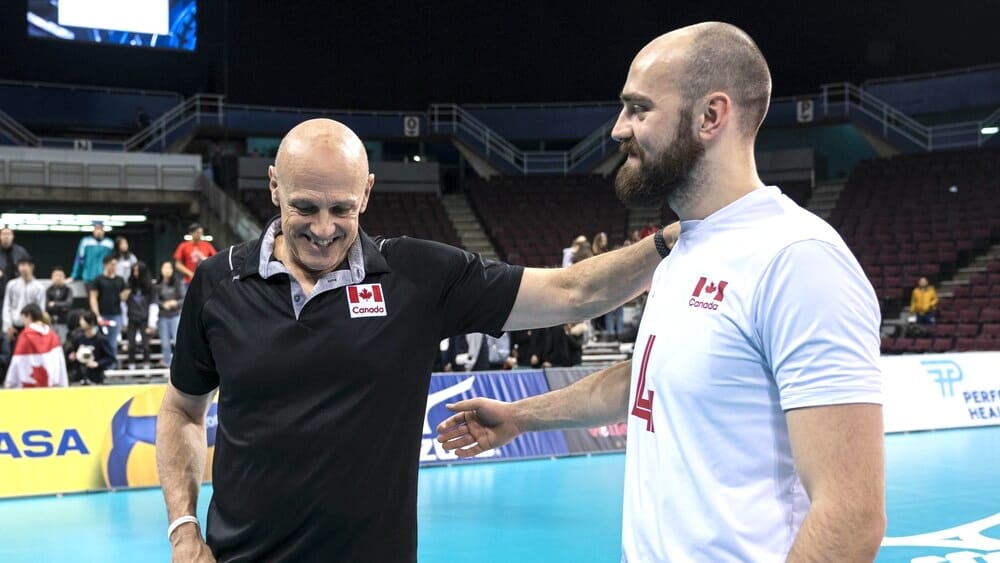
Glenn Hoag was head coach of Canada’s senior men’s national team from 2006 to 2016 and again from 2018 to 2021.
He took Canada to its first NORCECA title, to the Rio 2016 Olympics and to Tokyo 2020. Before that he won the French Cup, the French Championship and the European Champions League with Paris Volley. He coached Arkas Spor in Izmir, Turkey for fifteen seasons, and he now shapes the club’s development program and coaching education.
In part one, Glenn walked us through the plan: the ten year project he started with Canada in 2006, and the systems, people and setbacks along the way. If you haven’t read it yet, start there. This second part stands on its own too.
 VolleyBrains
Part one was about the plan. Part two is about the tools.
Glenn shares his screen for most of this conversation. He opens the two models that Charles Cardinal handed him at the start of his coaching career, the platform he built with his son Chris for the coaches at Arkas, and one of his own match sheets, scouted by hand, touch by touch. So this is one to watch as much as to read.
This second part explores:
- The coaching cycle: status, demands and context first, and only then forecast, prescribe, implement and assess
- The performance factors model: what a coach can influence, what he can’t, and why the gears all turn together
- The skill “spider web” for every player, and how to work on one player’s weakness without stopping the whole practice
- Weekend coaches, eighty practices a season, and going from one ball touch a minute to way more
- The coaching hub at Arkas: drill bank, planning, performance indicators and evaluations in one place
- Why only one percent make it to the elite, and why assessing still matters for everyone else
- His hand scouted match sheet: the serve coefficient, the traffic light for reception, and the plus minus ratio (clip 9: a must watch)
- The rule of seven unforced errors per set, born in Paris when the rally point system arrived
- Why pointing at a problem is never enough: offer the athlete a solution
We have 50 minutes of interview with coach Hoag in this article. Enjoy!
Enter Glenn...
Matias: You mentioned a slide from Charles Cardinal that shaped how you plan as a coach. Can you walk us through it?
Glenn: This is actually one of the two slides that stayed with me from when my mentor first worked with me, when I started as a coach. As I told you, Charles Cardinal was very much a periodization guy, a very logical guy. He showed me this and it really stayed with me, because for me it was very comprehensive.
Basically, every time you work with a team or an individual, you do an analysis. You need that before you can forecast or set your goals with the athlete.
The status is more about the profile of the athlete. Girls, boys, age level, experience level, strengths and weaknesses. But profiling is always continuous. This cycle is not a one time thing.
The demands are basically the demands of the sport. We’re not marathon runners, we’re volleyball players. It’s a skill based sport, a strength and speed sport. Coordination and agility are more obvious. So I’m not going to make them run for hours. I remember seeing the Korean team running for a couple of hours to get some conditioning, which is completely counterproductive. It’s important to know the demands of your sport before you work with it.
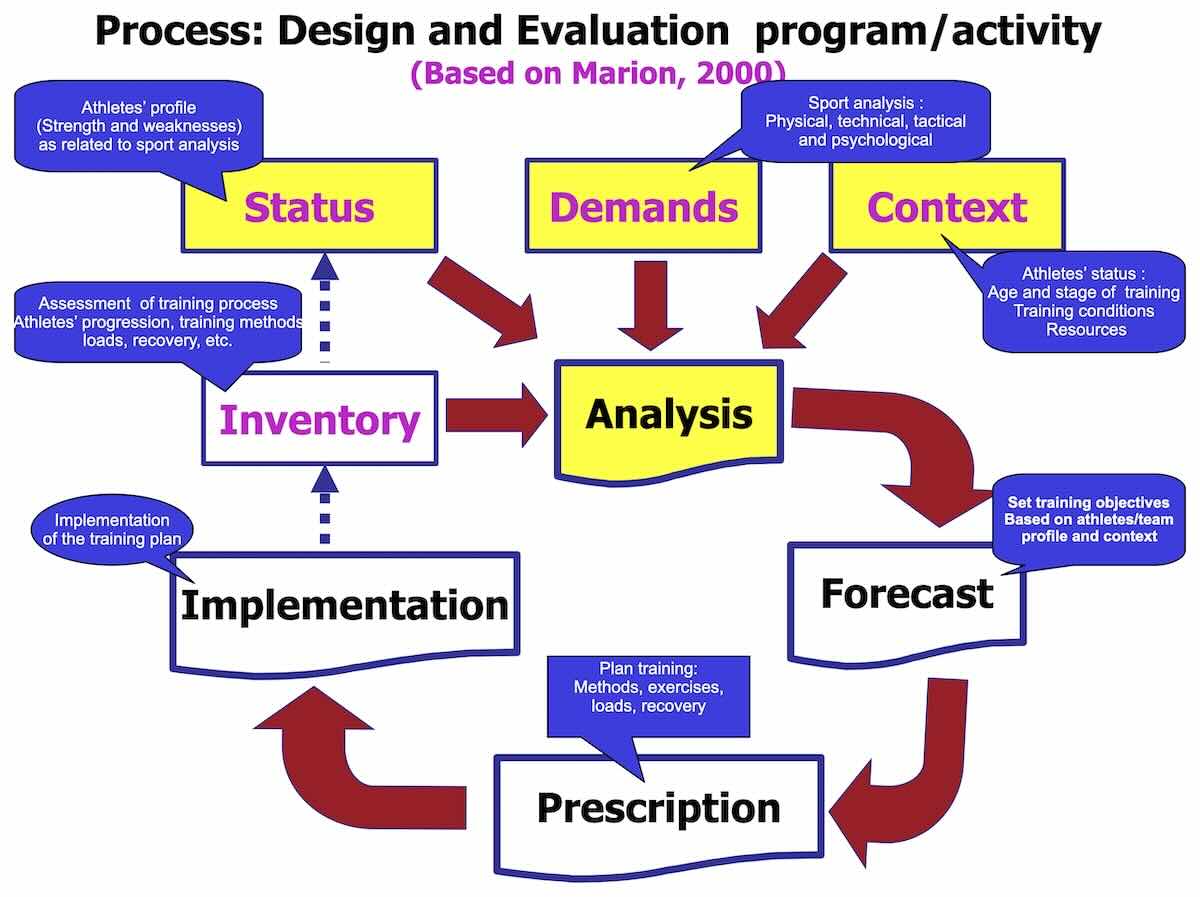
The context is more related to your equipment and the number of sessions that you have. For example, I went to Africa one year. We were on a tour with Éric N’Gapeth and a group from the old Fréjus team. Éric was going into retirement and we celebrated by going with him for ten days there. One coach came to me and said, “Hey coach, I would like you to help me organize my practice.” I said, “Okay, how many athletes do you have?” He said forty. I said, “How many courts do you have?” He said one. “How many balls do you have?” He said one.
Okay, well, we’re going to have difficulty. When we came back to France, we sent a bunch of old balls and stuff to help them. But anyway, that’s context. If you’re going to forecast the progression of 40 athletes with one ball on one court, it’s probably going to be slow.
So it’s very important to identify your context, so that when you forecast and set your goals, you set realistic objectives.
Here at Arkas I train five times a week, with three weight sessions. I can do individuals in the morning. I’ve got all the equipment in the world. So when I start forecasting, progression will probably be faster than if I have two sessions a week, no weight room, no morning session. A high school coach in Canada, for example. That reality is really important.
When you’ve analyzed these three aspects, then you can forecast. Forecasting is setting objectives of progression. And that’s not only from a technical aspect. It could be from a physical aspect, or from a psycho emotional aspect. This girl is a little bit stressed when she’s in a competitive environment. How do I work on her confidence, and stuff like that?
Then the prescription part is more about planning training. Which method am I going to use, the exercises, the load, the recovery.
The implementation part is obviously just, okay, I run the training. I run the weight training, or the volleyball training, or the mental enhancement session, depending on what it is.
And then the very important part, for me anyway, is the assessment, the inventory. How do you assess? What are your performance indicators? Assess progress, then go back to status, and around again. This cycle is continuous.
That’s why I was talking earlier about some of the problems I had with one of my coaches. When I went to see his practice, he was not going through the cycle. Maybe not so much the forecasting. The objectives of the training are this, I’m going to use these exercises, and I implement. But once he had implemented, he just let the practice roll. There are things happening and you’re not assessing. The practice was kind of all over the place, and he never stopped it. He just ran his practice.
It’s okay to run the practice, but you do need to profile your athletes and your team as you go. Is it going okay? Is this what you want? You could even stop it and say, “Yeah, this is what we want, guys. This is what we’re working on. It’s going well, keep going.” Or, like in that case, as soon as they started doing six on six, it was a big mess. Okay, let’s stop. “Hey guys, remember this, this, this. We want better quality here. We can have better quality in this situation. Let’s go back.”
So this assessment has to be continuous.
Matias: You said there were two slides from Charles Cardinal that stayed with you. What was the second one?
Glenn: This was the other model that Charles gave me.
The performance aspect can be your team or your individual. And the factors around it are the factors that you as a coach have influence on. That’s what you want to enhance. For example, muscular qualities, motor skills, health, energy production systems, if you look at the bottom left. At the top are the ones more related to skills.
And this is very much the case in all aspects of life. You can develop skills. If you want to be a teacher, you’re going to have to develop teaching skills, and so on. So these abilities have to be developed.
Individual tactics is more decision making, but from an individual perspective. And we do a lot of that in volleyball, decision making based on cues. I’ve got one block, I’m going to hit beside it. I’ve got two blocks, I might use the hands. So I’ve got to develop certain abilities on that side.
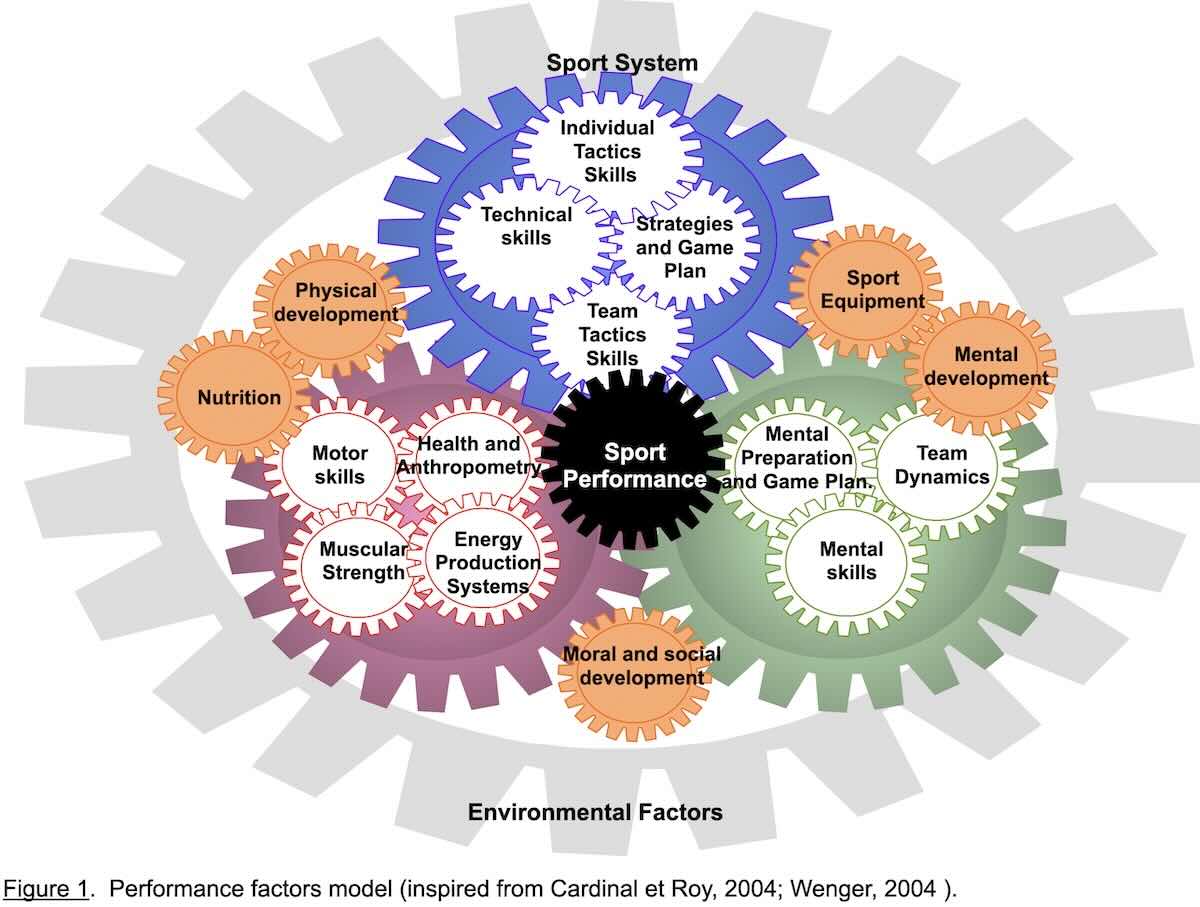
Some of the abilities are technical. Just basic skills like hitting, passing, setting, serving. Individual skills. And then if you go to the right, it’s got game plan, match plan. Those are aspects of how I’m going to get ready and develop my strategies to move into a game situation.
And the bottom one would be team tactical skills. That’s how the team responds to a cue. The ball’s coming over, how do we back up and run, let’s say, our quick attack and shoot sets outside, versus a pipe? We do respond, we have that set up, we’ve worked on it.
Then the green part at the bottom is more related to the psycho emotional aspect of the game. Stress management, motivation, confidence, and so on.
So these are aspects that the coach can somewhat influence. The orange part are areas that we have less influence on. For example, their nutrition. We’re not with them 24/7. We don’t know what they could be eating. We could suggest things on what they should eat, but in the end we’re not with them. Do they eat enough? Do they eat the proper things? We can always suggest things, but we’re not with them. Their parents might be feeding them a lot of carbs and no meat or no protein.
Physical development is often based on genetics. Sport equipment goes back to context, as in the example I gave earlier. Then there’s cognitive development, and also social and moral development, which is friends and so on.
And Charles, maybe if I click on the presentation you’ll see it, he puts them like gears, so that they all work together. They all affect the athlete and the team.
Matias: How do those two slides come together in your day to day coaching?
Glenn: These two slides were put to me and they talk to me. Maybe for other coaches too.
So when I’m using the Marion model, I’m going to be profiling. What am I profiling? How is this athlete physically? How is this athlete health wise? Am I working with a diabetic kid? How is their agility, how is their coordination? And then the technical abilities, the decision making abilities, the information gathering abilities, and then also from a stress perspective, and so on. That’s what I need to profile. It is complex.
And then I go to the Marion cycle. I prepare practices, set goals, identify the flaws, and then, what can I do to improve them? What strategies will I use to improve them? And so on. This is kind of the way my brain has always worked. I was lucky to get that early. Again, those slides speak to me.
And then it’s developing the knowledge on how to do it. A little bit on physical development. A lot, probably, for volleyball, on the skill aspect and the decision making aspect, because it’s a major one. A little bit on how to help that person deal with stress or their confidence, and stuff like that.
Then there are different skills. Charles was always talking about developing competencies. You’ve got knowledge, but you need competencies. And those were value based. Critical reflection was an important one.
You decide on a strategy, you go through the strategy, and at one point you measure. And then you need to decide what to do. Did I reach this? Did I get Susan to pass better after six weeks? If not, what do I need to do? That’s why I need to go and look back at what I did.
And that’s why planning becomes important. If I don’t know what I did and then go back, what am I looking at? I’m looking at nothing.
So I’m going to keep doing the same thing, and then Susan’s not going to get better.
So I need to look back at my strategy. Maybe it’s communicating. Maybe I’m not choosing the right exercises for that person. Then I need to find what it is that I need to do to get Susan to pass. Because I know if she passes better, she’s going to gain confidence, she’s going to be happier playing volleyball, she’s going to feel that she’s supporting the team and helping the team.
And that’s where the complexity is. I was talking to my coaches in Turkey, and I said, it’s a lot.
It’s a lot. I guess it’s normal that when you guys finish a practice, you should be tired mentally. That’s how hard coaching is.
So I was lucky to get that, and then to develop the tools takes time. Now we have a lot of information available everywhere, online and stuff. At the beginning it wasn't really there.
Matias: But I guess just a picture of all the wheels, and then seeing the wheels in motion, just to know that all these different aspects are intertwined and work together, to have that gift. Twenty five years ago you got that gift. I think that’s really amazing, because people are still figuring that out.
Glenn: Yeah, for sure, Charles, was the man.
And it is amazing how they’re so intertwined. You realize that when somebody gets an injury. This pain, whoop, what am I going to do? Am I going to keep going to the blue part and say, okay, keep swinging? No, I’ve got to pull them back. Listen, we’re going to take care of this. We’re talking about health again.
And then, how is that affecting my athlete? “Oh no, I’ve got an injury. I won’t be able to play. Is that the end of my career?” Some people take this in very extreme fashions.
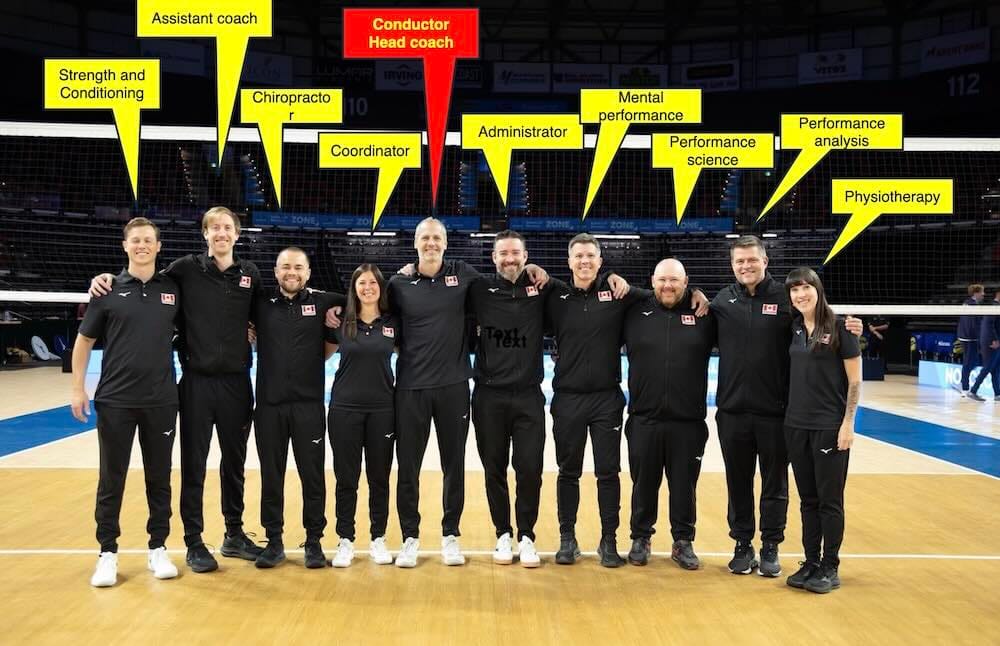
So now I’ve got to think about return to play for this athlete. What will I do? I’ve got to talk to my medical staff. Again, the orchestra. I talk with my medical staff and see how much time we have here. What does this athlete need? And then talk to the strength coach, because we’re going to find exercises to strengthen that shoulder and slowly get him back to the activity.
That’s why, like you said, it was really rich to get those slides from Charles early on in my coaching career. And then to start developing more of the knowledge, and how to use those tools to enhance these factors.
Matias: It’s a great incentive to start developing your own tool set, because you know that all these different wheels are intertwined. Your coaching career is spent understanding which wheels. And it’s all of them. Every single one you can imagine has an effect. But then it’s about which one I can adjust, and which one is out of my control.
Glenn: Exactly. What can you control. That's exactly it.
Matias: You’re now teaching these ideas to the coaches at Arkas. How do you get them to look at each individual player, skill by skill?
Glenn: This is what we’ve been working on presenting to the coaches, like I was telling you about. It’s how I perceive my team, with each skill, and how I can enhance it.
We tell our coaches, let’s take the setter for example. Obviously we want him to be a good setter, so setting is important. But if I do enhance his blocking, if I stretch that part here towards block, and a little bit this one towards dig, well, then my area of expertise becomes bigger. I become harder to defeat. If his serving is better, maybe I’m putting more pressure, and so on.
This is something we presented to our coaches this week, when we did some of our teachings. And that’s why you need to be able to assess their progression individually on skills. The difficulty we have right now is the fact that they’re not assessing well enough.
They were asking me, how do you organize your training if, let’s say, Peter has trouble on receive? How can I organize to work on Peter’s receive when I have to think about the whole team? Well, I said, you can take five minutes, 10 minutes at the end of practice. Or maybe you create a drill where Peter is a little bit more under pressure from a receive position, and then work with him in that context. But the team is still working.
So this is some of the stuff that we’re doing right now to help them get more flow in their practice, and not have to stop for every individual. And I said, also organize a period. It’s not going to take Peter one practice to get better at receive. Maybe you do it over six weeks, and then at the end of six weeks you evaluate and see. Hopefully you can have matches to evaluate.
So we told them, you need to have some data on this so that you can evaluate, and then from there you can try to get them to progress.
And again, if Gavin Schmitt digs one or two balls more, then it might be one or two balls that make the difference in the end, that I might be able to set and convert. If my small setter can deflect a couple of balls positively into my defense, then so be it. That might end up making the difference in the result of the match or the set.
Matias: Many questions here for me. The first one is how to be objective about where you are and where you’re going. For example, the difference between Gavin Schmitt, opposite, and Blair Bann or Dan Lewis, libero, on the facet of defense. If Gavin is defending three balls a game and he keeps them on your side, okay, this is an awesome opposite in defense. Is this already pushing him to the upper end? Is this weighted scoring? That’s probably my question. If this is a libero, then yeah, we’re going to really focus on that skill. But if it’s an opposite that digs three balls in three sets, one ball a set, that’s a pretty good result already. How does that go into these spider webs, so to say?
Glenn: The big thing is, I’ve had to look at the game globally. With Canada I didn’t have the best. I had one Gavin Schmitt, I didn’t have many Gavin Schmitts. And we’ve had other opposites that maybe weren’t Gavin. We still had this global approach for it.
One thing is, on that image I don’t have the libero as well. But the philosophy was to try to enhance everybody, even in aspects where they’re not so good, to maybe go and grab another point here, another point there.
For sure, if you have Poland, where the guys all have a great level of skills, especially individually, for their specific position, you know you’re already in pretty good hands. Also, they have enough players to have three starting sixes, or even four. I only had a group of maybe twelve, fourteen, with some players to come in. So I always approached it that way.
And also, our level of ball control, in the back row especially, was not very good at the beginning at all. So we needed to really put the emphasis there and grow from there.
And as I told you earlier, it kind of dawned on me in Italy in 2010 that we’re digging great, but we can’t transition kill. So if you look at one of the outside hitters, then if you look at the attack you might be saying, okay, attack in system, no problem. But as soon as we’re out of system, we’re not scoring. So I’m going to have to work with this guy at hitting balls out of system, and being more efficient in that part.
And because we work a lot with young guys at the club here, we do try to have the same approach. So that we can form good volleyball players, good Turkish volleyball players, and not just one dimensional or two dimensional ones.
And often, especially with opposites or good attackers, especially when they’re young, it’s “Well, that’s what I’m good at.” Yeah, but eventually, when you go to the next level, if you’re only good at this, then you’re going to be costing us.
Matias: How many coaches do you have in Arkas right now? How many teams are there?
Glenn: You know, the Turkish women have won the European Championship. They won VNL. We don’t have enough room. So we have about twenty four coaches. We have part time coaches on weekends. Those are the important ones. We actually had a course just on planning for them.
They have two practices a weekend, but over the span of the season they have close to eighty practices with the same groups. So we really needed that. Because when I went to watch, kids were waiting in line. The sessions are an hour, fifteen minutes. The coaches would run long warmups with the little ones, and then they would touch the ball for twenty minutes. And they would touch the ball in line. You wait, you bump.
So I would put my watch on. Okay, this girl touched the ball one time in one minute.
So we completely changed it, and the parents are very happy actually. We said, no need for a warmup at that age. Just start your warmup with balls and they’ll move, and they get to touch the ball. And organize your drills. Then we taught them. We said, here’s how you can get them to touch fifteen balls in one minute, instead of just one or two.
We really had a lot of work to do on this one. But now, with this platform and with the teachings, we’re able to do so. Because there’s a rotation on weekends. We have permanent coaches within the structure, I would say there’s about maybe fifteen, sixteen coaches, and then the rest are all weekend coaches.
And those are the ones we do want. Because again, we treat it really as, the kids are our clients, and we need to offer the best possible experience for them. The little ones, even the older ones. So we do press on that quite a bit.
Matias: The popularity that the sport has now in Turkey is really insane.
Glenn: It’s crazy. It’s nonstop. Again, there’s the demand. Arkas has some schools, and we’re using these schools now to get gyms. We have to send coaches across the bay to the other side, there’s demand there as well. It’s insane.
Matias: You built a platform for all of this together with your son Chris. Can you walk us through what’s in it?
Glenn: So we can see here the different areas where the coaches can go, the different resources that they can get.
One is coaching resources and documents. If I click in there, I could show you what’s called the mission statement and our vision. This is with Mr. Arkas wants to push also, it’s all about using the sport platform to develop good citizens, good volleyball players.
And then you’ll have the LTAD stuff, the long term athlete development model. We shortened it, but we gave the basic things that we needed to do, especially with younger athletes.
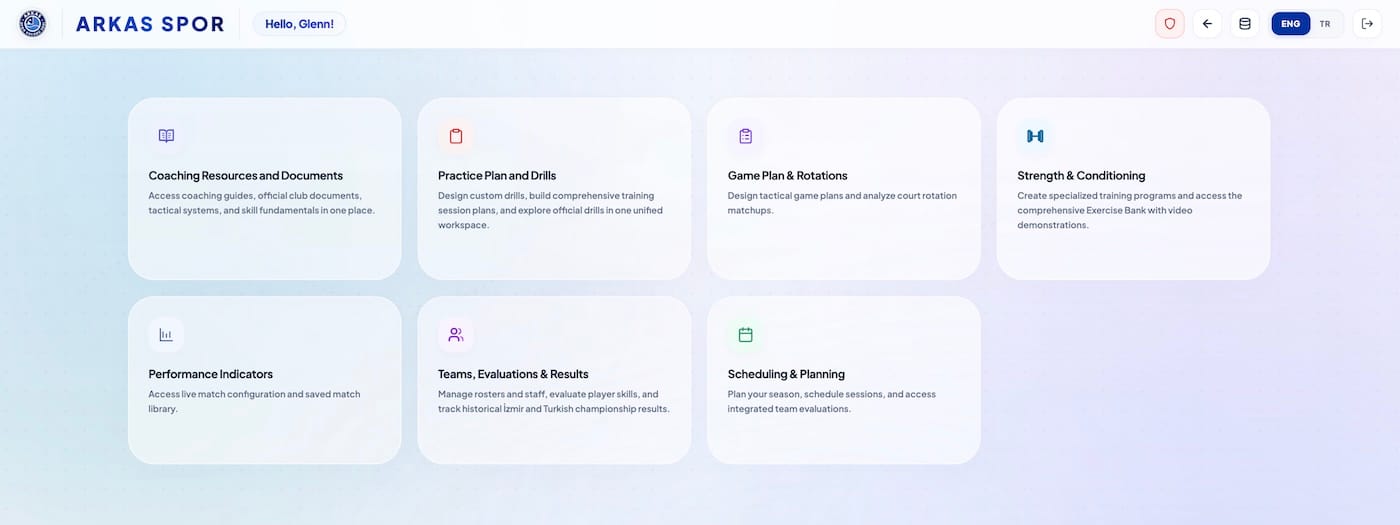
The second one is where they can get practice plans and drills. They can create their own drills, and we also have a drill bank. Chris translated all my drill bank and stuff.
Matias: The drill bank, is that sketches, or is there also some video here and there?
Glenn: Mostly sketches, yeah. That’s a good idea. Actually, maybe I’ll talk to him about that. That could be fun.
Game plan and rotations, so stuff for some of our more advanced coaches. We wanted that. Part of the problem here, I think, is that some kids, especially with the men, are not schooled so much. We want them to do a little bit more cognitive exercises, like learning about a game plan and applying a game plan, and stuff like that.
Then strength and conditioning. This is mostly used by our strength coaches. They have the sheets, and then the different little images, and the different methodology.
Performance indicators, here they can do it themselves. Chris created a template with the video, and they can click through it themselves. It’s a basic one, kills and digs, but they can do it themselves. And they’re actually doing pretty good.
And then we have evaluations. For the very little ones, the platforms that we have to evaluate our kids, to profile them, are a little bit advanced.
So for the young kids on the weekends, which are really little, the coaches have to give us a report every month. We have them every weekend, so we want to see the progress.
But they’re very simple evaluation sheets for the little ones.
And then some of the stuff here, like manage rosters, add players. This is where you input all the teams. Every coach can put in their own team, and then it spreads to the rest. So he’ll have all his players on his practice sheets.
Matias: So this is more your admin.
Glenn: Yeah. And then scheduling and planning. We’ve started with that. We always start with that. And they’re doing pretty good actually, as far as planning. As I told you earlier, part of the problem is the in time assessment, during the session. This is a thing that I’ll need to work on with them.
This is an example of the sessions. You see, this is our division one men. The players have already been put in, and then it’s output to their session plan. Then they go to the drills. They can create their own, or they can go directly to a drill and put it in.
So it took us about a year to create, and it’s a lot of the information that I was able to pass on to Chris on basic philosophy. The Marion cycle is in that documentation. The one about the performance factors too, physical development, technical development, mental, cognitive, psycho emotional.
We’re still very much in the teaching phase of all these things, but they understand somewhat what’s needed. So that’s what we’ve done for our club. It’s kind of a legacy that I wanted to give the club.
I’ll be frank with you, I do miss coaching, and I miss the competitive environment. But on the other hand, it’s something I really do like to do. And I find it’s really useful.
We’re really focused on our club. We developed this for our club. I told you, we treat our athletes as clients, and we want to give them a good service.
We do a lot of education with the parents now as well. And the last year we’ve had a lot of positive comments from the parents. So it’s better structured.
Matias: Most of these kids will never play at the elite level. Why does assessing and planning still matter for them?
Glenn: I read recently that some coach said, we’ve got to stop putting pressure on our kids. Only one percent will make it to the elite. For the rest, we use the sport platform as a great platform to have the pleasure of playing a sport, to maybe stay in shape for life, or if you enjoy playing basketball at forty with your buddies.
We’ve got to keep that in mind, and we do tell them. In the LTAD model they talk about sport for life. You start at a young age, and we want you to do sport at 70. And it is a reality. Don’t make the kids hate the sport, or hate sport in general.
It is a competitive environment, and they’re going to learn about competition, winning and losing, effort.
We know that the sport platform is a great platform for life.
And I think, even for clubs anyway, make an assessment as a coach. If you want that person to progress, and you don’t know where that person is at, or you don’t even care, you’re just going to run the same practice. Again and again and again, then go play your weekend.
But if you structure something, because you say, well, his free throws have to be better, well, then the practice is free throws. And you’ll see progression. It doesn’t matter, just take the time to assess a little bit.
I was in northern Quebec, in a remote area. I went to give a clinic. And the people love sport there. They love sport, but it’s super cold. They were running beach tournaments, and it’s right on the Saint Lawrence River, but where it reaches the Gulf, the ocean. I was there in August, but it was cold. And people are playing beach outside.
Anyway, I was giving a clinic, and I was telling them the importance of assessing, even in a small measure. I showed them performance indicators that were really easy, not complex ones. And giving feedback to your kids, and stuff like that. And they were very receptive actually, because they love sport.
That city, I don’t know, they just love sport. There’s a lot of native community around, and they do play sport quite a bit. And they have this tournament. This is one of the biggest volleyball tournaments, I think, in North America. People go there in May to play. It’s called the Tournoi Orange. And it’s massive. All the hotels are full, and it’s not a huge city.
But anyway, they were quite receptive to this, and to understanding that, yeah, we do want our kids to continue to play volleyball.
And then they need to progress, because the better they are at volleyball, the more they’re going to enjoy playing volleyball.
You have to keep it simple. It’s a simple thing really, but sometimes parents kind of make it difficult.
Matias: You are an extremely organized coach. Where does that come from, and let's dive a bit deeper in the development of your pro team performance indicators?
Glenn: When I was in Sherbrooke, at the university, I had a very heavy load of work. I was the coordinator of volleyball, I was coaching the men, I was financing the teams, organizing all kinds of things. I was overwhelmed with so many things.
It was during the big recession of 1992, around that time, and I ended up having to take over the intramurals, organizing all the recreational sport for the university. I would get up at seven in the morning and be home by ten at night. It was ridiculous.
Anyway, when we left for Paris, I asked for a leave, and I went from 1999 to 2003. And then I was really able to focus on just coaching.
I had developed performance indicators, small ones, where I would assess. And I still use them to this day. I still get reports from Data Volley, but it doesn’t speak very much to me. I do understand it.
But when I do the assessment of our match, for example, I’ll have an assessment of each and every skill, and every touch on the ball.
That was important to me because it helps me understand the outcome of the match. Win or lose, it doesn’t matter, because the results can be false. “Coach, we won 3 0.” Yeah, but that team wasn’t very good. We’re going to play some much stronger teams later on. So the indicators would be the ones that would tell me, okay, we had a good match, yes, and we won against a weaker team. Or we had a very bad match, but we still won against a weaker team. I can give you an example.
So I do this by hand. And what it did is, I could go back and forth and look at why, let’s say, an attacker was having a bad day, or a passer was having a bad day. This passer is having a bad day, yeah, but it’s Abdel Aziz bombing serves at him, versus easy serves where he’s struggling. Or is it communication between my passers? Why is it that we’re not performing in this skill?
Or this attacker only got high balls against three blockers. Because if I look at the number, it tells me that he’s at 10% efficiency. But what happened? Why does he have 10? The number is easy, but I’m not going to start doing the blame game. I need to go and look.
So I would have a sheet next to me where I would write down the outcome. As I’m taking it all point by point, receive, setting, attacking and so on, if I see certain things on the video, I would write down, okay, this is why, this is the problem I need to solve.
And why I use all this is, I debrief on the Monday. I would play on the Saturday and debrief on the Monday. So I would do that on the Sunday. I would prepare the debrief, but then I would also prepare my sessions for the week.
What we need to fix, what we need to work on. What are the performance indicators telling me?
Matias: Can you show us what that looks like on one of your own match sheets?
What to look for in the video
- Serving is judged on pressure, not on aces. Every serve gets a value, from error to ace, including high balls and overpasses created. That gives each server a coefficient. Above 1.5 is a good serving match for Glenn, even with a few errors in there.
- Receive works with a traffic light. From green to red, so coaches and players have a simple reference. The coaching question becomes: what is your strategy to keep this passer in the green?
- First ball attack and transition are scored separately. For a receiver attacker, Glenn’s base is about 30% efficiency on first ball. In transition, winning 25% of the points is already good, because so many of those are high ball situations.
- Overpass kills get their own column. A middle who scores eight points, three of them on overpasses, looks the same on a standard report. Glenn takes them out, because he wants the attack number to say something about the setter and hitter relationship.
- Plus minus: what you scored against what you cost. He separates unforced errors from the ones the opponent had to work for, like an ace or a block. Around 50% and over, you are on the winning side.
- The same numbers per set. That is how a set lost by two points suddenly has an explanation.
(transcription from minute 9:14 to the end of the clip)
Glenn: When I do this, I have that sheet next to me, and it’s just per sector of the game. Our attacking, our serving, our receiving. It’s just a few lines. I see this, I write it down. And this is really just to help me prepare what’s coming. How do I prepare the next practice? What do I need to work on?
I do have my scout man, and sometimes we compare notes, just to confirm certain things. Or we’ll pull out some actions where I say, I’m not so sure about this, what do you think? And then we discuss, to have the most accurate measure possible to prepare.
Then I’ll meet the athlete. We’ll have videos prepared to show them. I think if we work on this, we can fix this. This is a bit low, here’s the reason why, and here’s what we’re going to do.
So I’m offering the athlete a solution. And that’s really important.
I remember listening to a coach one time, in the French championship. He calls a timeout, calls everybody over, and he says, “If there’s one area where we’re really bad, it’s serving.” But no solutions. So the guys go back on the court thinking, we’re really bad at serving. What about telling them, okay, let’s go back to basics here, let’s focus on our toss?
Give them solutions. Otherwise they just don’t know.
Matias: It’s an insane amount of manual work to do this. Are you able to do this without pausing the game?
Glenn: No, no, no, I pause. I’ve got my arrows on my Mac, and the slow mo, going back and forth. I spend a lot of time. I’m a bit of a maniac.
But I started this a long, long time ago. Can you imagine? I used to do it with VHS cassettes. I would have the remote and go back and forth and then do it. I wasn’t as advanced as this.
But when I was in Paris, it dawned on me, when the rally point system came, that if you have more than seven unforced errors per set, you’re going to be in trouble. If you can keep it under that, you’re probably going to be able to compete.
And I look at it all the time now, because on TV they show the number of errors by teams. They show the number of points you scored on attack, block, serving, and then at the end they put opponent errors. So for example, Belgium had nine errors, France had six. So you see in the column of Belgium, six. And sometimes it gives you, here’s the reason why they lost, because they made so many errors.
So what I did in Paris is, I went from there and said, guys, we need to play, not errorless volleyball, but we need to make our system so that we’re able to limit errors. And if we keep it like that, we’ll be able to challenge many teams.
I do remember some matches. It was right during the switch to the rally point system, and we played Friedrichshafen. Friedrichshafen had big servers, big, big, big servers. They were just bombing serves. I said, let’s let the storm go. We lose the first set, very tight. And then after that they made so many unforced errors. They kept bombing and bombing and bombing. We won three one.
So that kind of gave me the idea. You just want to enhance your game, and then try to keep errors under control.
And that’s what I did with Canada at the beginning. Stop trying to serve your way to victory. We need to be better at other things. Remember that first plan I showed you earlier? This is how I approached it.
Thank you, Glenn.