120. Glenn Hoag: I don't control the outcome. I do control the process.
The first half of a wide ranging conversation with the coach who rebuilt Canadian men's volleyball: a ten year plan, a program with no money and no benchmarks it could meet, and the systems, people and setbacks that took Canada from nowhere to Rio. Part one of two.
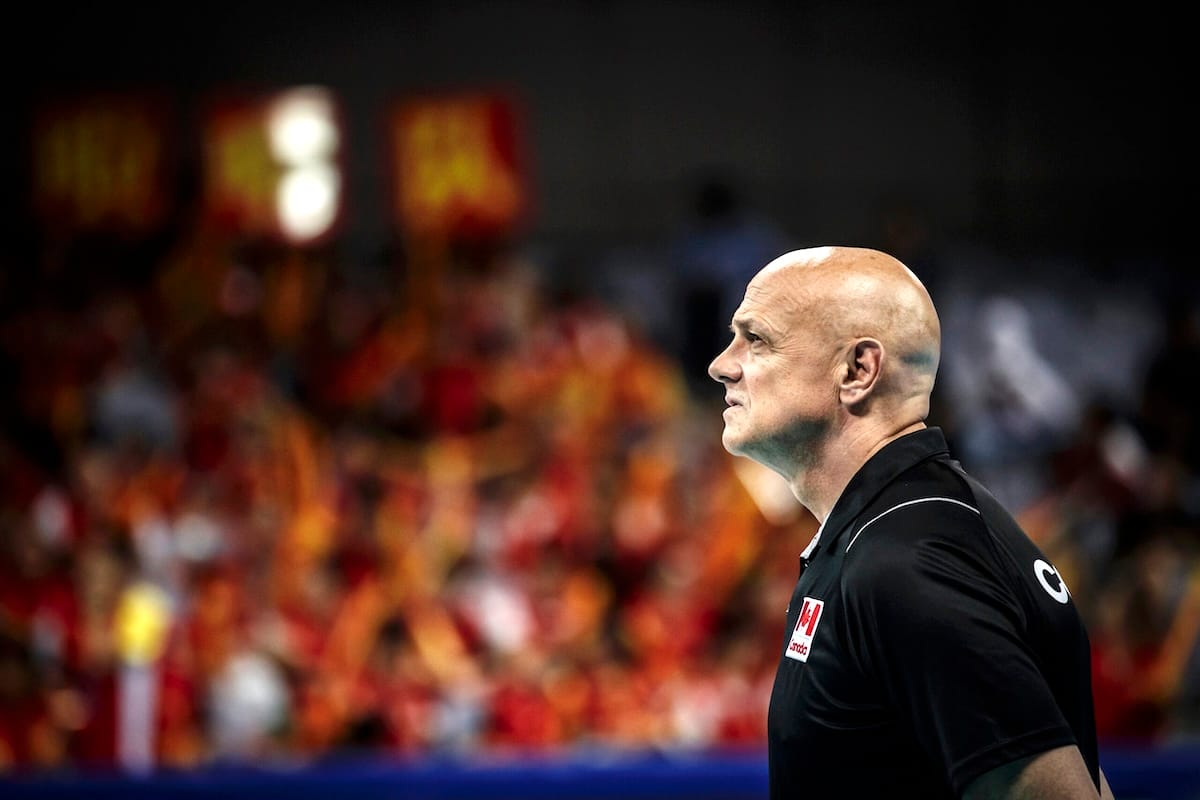
Glenn Hoag needs little introduction on VolleyBrains. He was head coach of Canada's senior men's national team from 2006 to 2016 and again from 2018 to 2021.
He led Canada to its first NORCECA title in 2015, and to its first Olympic Games since Barcelona 1992: the Rio 2016 Olympics. He then qualified the team again for the Tokyo 2020 Olympics, held in 2021. Before Canada, he won the French Cup, the French Championship and the European Champions League with Paris Volley in 2001, and was assistant coach of the French national team through to the Athens 2004 Olympics.
He coached Arkas Spor in Izmir, Turkey for fifteen seasons, and he now shapes the club's development program and coaching education. He is a member of the Volleyball Canada Hall of Fame.
Glenn first joined us in 2022 for Masterclass 31. This time, he opened up his slides and his notebooks, and one theme ran through the whole conversation: development.
 VolleyBrains
Developing players who arrive as student athletes and have to meet the demands of the international game. Developing coaches, from the integrated support staff and the junior and Canada B team coaches, to the weekend coaches running practices for the youngest kids at Arkas. Developing a whole system, so that what the national team does is brought to the provincial centres and the junior program. And developing himself, through the mentor who handed him the models that still shape how he coaches.
Along the way, we also talked about what robustness really means, why he scouts every match by hand, the coaching hub he built at Arkas, and the volleyball boom in Turkey.
This first part is about the plan. Glenn walks through the ten-year project he started in 2006: the systems, the struggles, and the players who made it happen.
This first part explores:
- The 2006 plan: why Canada tried to "serve like Italy," and how Glenn turned a team that beat itself into one built on limiting errors
- Charles Cardinal's orchestra: why the head coach has to conduct, and how to lead strength coaches, mental performance staff and physios without confrontation
- The plan versus the reality: injuries, failing to qualify for London 2012, losing the January 2016 qualifier, and getting through in Japan
- What an astronaut taught his team about stress, outcome and process
- Leaving his family to coach in Slovenia so the program could keep his salary
- "If you come to my field, you get your hands dirty": choosing development coaches over recruiters
- Robustness, Nassim Taleb, and the stories Glenn tells employers about his former players
In part two, coming Sunday, October 11, Glenn opens his toolbox:
- Charles Cardinal's coaching cycle and performance factors model, the two slides that shaped how Glenn thinks as a coach
- His hand-scouted performance indicators: the serve coefficient, the plus/minus ratio, and the rule of seven unforced errors per set
- The skill "spider web" for every position, and how to work on one player's weakness without stopping the whole practice
- The coaching hub he built at Arkas, how they go about developing young players
- Why only one percent make it to the elite, and why assessing still matters for everyone else
We have 40 minutes of interview with coach Hoag in this article. Enjoy!
Enter Glenn...
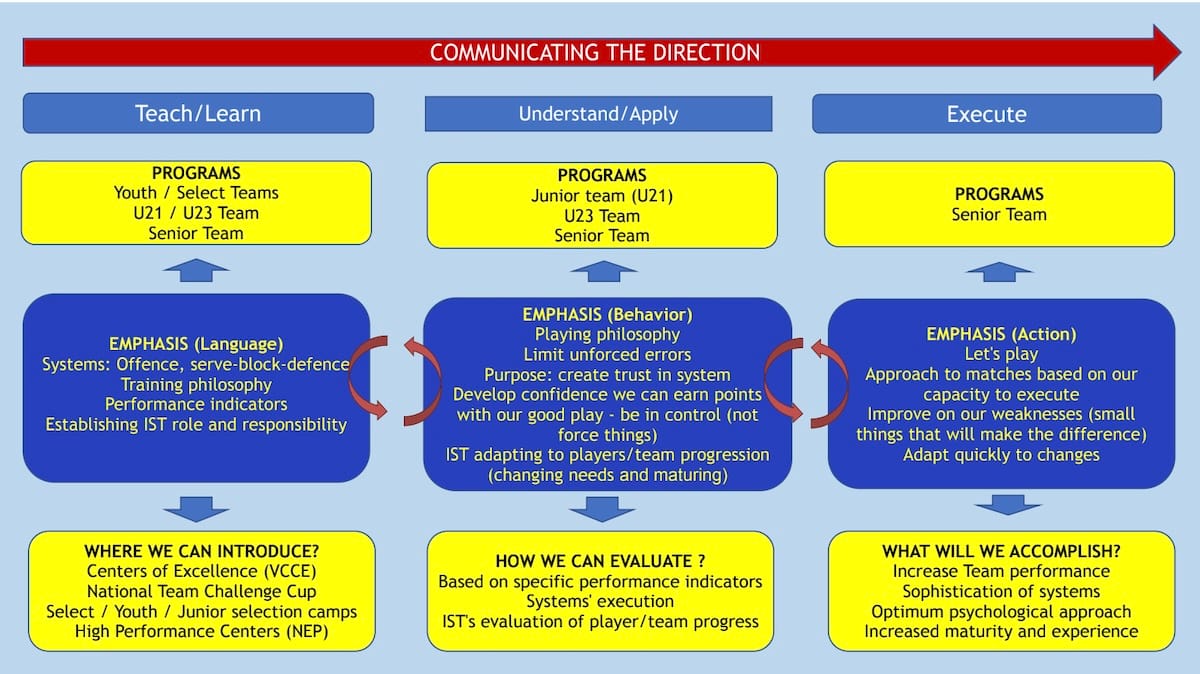
Glenn: So this was the plan. In 2006, when I took over the program, I knew we needed to change things not only with the senior team or the national team program. We also needed to give some direction domestically and clarify our systems. So I set this up.
If you look at the middle part, the blue part, understand and apply: emphasis, behavior, playing philosophy, limiting unforced errors. Purpose: create a program of trust and systems.
As I told you earlier, I learned a lot about the Canadian system. I knew it from being a university coach, but not from the national team perspective. When I was with France, up until Athens in 2004, we played Canada twice. Once was the Olympic qualifier for Athens and the second was the World Cup. I did the game planning to play Canada at that point, so I knew their strengths and their weaknesses.
Part of the problem, I think, is that we were trying to imitate other countries. Okay, we have to serve like Italy, or block like Italy. We didn't have our own philosophy.
And what I found is that Canada made a lot of mistakes.
They tried to serve their way to victory, and they weren't the most consistent serving team.
Both times, we beat them 3–0. France, being a more skilled team, was able to handle their big serves, and the rest was mostly their errors. The other problem was that they had no back row strategy. It was pretty easy. We mixed up our attack, made sure we didn't give them the big blocks, tipped a lot, and really destabilized them completely. It wasn't that hard to beat them.
So this was the base for me to start limiting errors and to build our systems. If you look at the first part, teach and learn: system offense, serve, block, defense, side out offense. I went back to really strict systems. I wanted the team to learn to earn points in each phase and not force things. If we're going to miss six or seven serves per set, we're not going to come out on the winning side of these matches, or even be able to compete properly.
So that's what we did. The emphasis, the language, the system, I needed to bring that not only to the senior team but also domestically. That's why, if you look at the bottom left, you see the Center of Excellence. At that time, we had some money, and each province had one of these centers with summer programs.
We brought those summer programs to the national team center, and we taught them how a national team athlete trains. He has to learn systems. He needs to eat well. We had conferences with nutritionists and physical preparation people. We ran national team practices with the kids. We even had them scouting and watching video of different teams. They would be in classrooms, and each team had to prepare a game against China or against Korea.
We guided them, obviously, but the idea was to seed what's needed at the high level.
I remember talking to the kids about the block defense system. The system I created at the beginning, I called it the floodgate system. You have three blockers at the front, and there are four gaps: the antenna, the first blocker, another gap, the middle blocker, another gap, the outside blocker, and so on. I said, "We need to train you blockers to stop the water from coming in.
You have to cover the net. You're the three gates, and we train you to be as good as possible at stopping the ball at the net. The second line of gates is the defenders. You have to stop the water from going out." And then we have to rebuild it. Obviously, we have to transition it. But with that concept, the kids thought, yes, there is a relation between the block and the defense.
Then we started implementing this system. At the beginning, I worked a lot on ball control in the back row, because I thought this was one of our weaknesses and we needed to build a good base.
The National Team Challenge Cup was another place where provincial teams would meet and where we would seed again. They came for the tournament, but two days early, so we could practice with each province and preach our systems to them. Then there was the junior selection camp, and the NEP, which was the full time training center for post university athletes at that time.
With the senior team, we really put the emphasis on very strict systems at the beginning. Not making mistakes, playing block defense with structure, learning to read a game plan and execute it. Parallel to that, obviously, I needed my players to become better passers, attackers and blockers. You have to do all the individual development and correction. Most of the athletes coming to us are student athletes. They're not full time athletes like many young athletes in Europe. For us, it's still the same system and program.
The problem we had at the beginning was that we weren't in World League, so I didn't have any measures to see our progress. In the summer, Australia might come for a tour, we'd play three or four matches in Canada, and then we'd have NORCECA at the end of the year. With that model, I didn't have any real measure.
We started in 2006, and the first solid measure we had was in 2010, at the World Championship in Italy. I remember we had the pool of death, with Serbia, Germany and Poland. It was a very strong pool, and for the first time we had really good data against strong teams.
That showed us where our level was. We couldn't kill in transition.
That was the first real assessment. Okay, we have to go back and get better at transition killing, maybe at transition setting off our digs. And that got much better. Parallel to that, our serving got more consistent. I still believe, even now, that the ratio of serving to receiving is a really important aspect of the game. You don't want to lose too much on your serve by making too many mistakes. You want to put the other team in trouble. And you don't want to lose too much on the receiving end either. Keep the ball in play and at least get a swing, even if you can't pass perfectly and run your full offense. We worked a lot on that.
The last part was execution: approaching the match based on our capacity to execute. We needed to get better and better at that, and we did. We improved on our weaknesses, very small things. Our defense got better, our serving got better. We took incremental steps, and we started having more measures in 2011, when we qualified for World League. That gave us a series of high level matches right at the start of the summer. Instead of training all summer and then going to our zone championships, we had real measures of progression.
That's where we started competing with others, which was the main objective: to bring the team to a level where it could compete against the best in the world. Not necessarily win all the time, but play good volleyball. And the players started embracing the system and being confident in what they were doing. That was an ongoing process, right up until 2016, when we qualified for the Games. That was the plan, from 2006 to 2016.
So anyway, I've always been a planner. That came from my mentor, Charles. He was a specialist in periodization, that's what he taught. So maybe his influence was really big. Watching Canada, I knew things were kind of going nowhere.
I just needed to give it structure and give it some direction.
The floodgate actually did speak to players. I have to train myself to stop the water at the net, and then I have to train in defense to stop the water from getting through. Everything else is a point for the other team.
Glenn: In the end there, I was talking about giving people references. The floodgate was a reference. Offensively, I had something else, but I don't remember it very well.
The floodgates really spoke to people. In some seminars I gave, I had the coaches line up at the end line with six, seven or eight balls. They had to roll the balls inside the lines of the court to the other side. The blockers had to stop the ones they could, and the defenders had to catch the ones that got past. It gave them an image of what I was trying to explain.
And I said, well, the balls that get lost are points for the other team. I told them I don't like what I call emergency situations, which are wipe offs. We really want to close the gap. Technically, we want to be able to turn the ball in, for example, and not give up a clear wipe to the outside, which is really hard for the second floodgate to pick up and defend.
We built things around that. After that, obviously, it became more sophisticated. When our guys got better at reading, at committing, at taking some options, those teachings came. But we started with the basics, and it worked fairly well.
Like I said, the assessment part was the difficult part for the first four years, until we reached the World Championship and then qualified for World League. I don't remember exactly how many matches we played in World League, but it was something like eight. That gave us value. Then the World Championship.
We started building a collection of data that could tell us, okay, this is what we need to work on, this is what we need to improve.
Before I left, I always told them in Canada, you need to think eight years ahead. We have a school based system and we don't have huge demographics. We want to imitate the US, but we don't have 360 million people. We barely have 40 million.
So we'll have fewer big players. We have very specific people per position. We needed to create depth charts and look at the players coming up. What were their flaws? What did we need to work on? And in a school system, you know you're going to lose some. Some guys are going to become engineers. They don't necessarily want to become professional athletes and play on the national team. That's our reality.
So while thinking long term, you always, always, always have to have a sense of urgency. That's super important. Every training counts. Every step forward counts. Every assessment we make has to be the right one, so that we can get this one player to progress to where we want him to go.
The other part of the philosophy was: how can I make my court hard to beat?
For each position, we have so many skills. We want our setter to be a good setter, obviously. A good playmaker, an accurate setter. But if he can also give us defense, blocking and good serving, and we enhance that part, then that position becomes more threatening to the other team. A good defender, a good blocker, makes our court harder to attack and harder to beat. And that goes for all six positions. That was the base of the philosophy.
I remember we did a lot of work with Gavin Schmitt. We wanted Gavin to be the big opposite, the guy who hits, blocks and spikes. But he was very conscious about it. He enjoyed that approach, and he said, "Yeah, okay." It wasn't always pretty, but he came to care about defense. Maybe the one, two or three balls he picked up in a game could make the difference.
I think that approach is what made us start competing with teams that were at a better level. And as the plan progressed, better and younger players came in, because we had started putting it in place at the junior level.
These guys integrated and were able to compete well, and eventually we qualified for Rio, which was our big objective in that ten year plan.
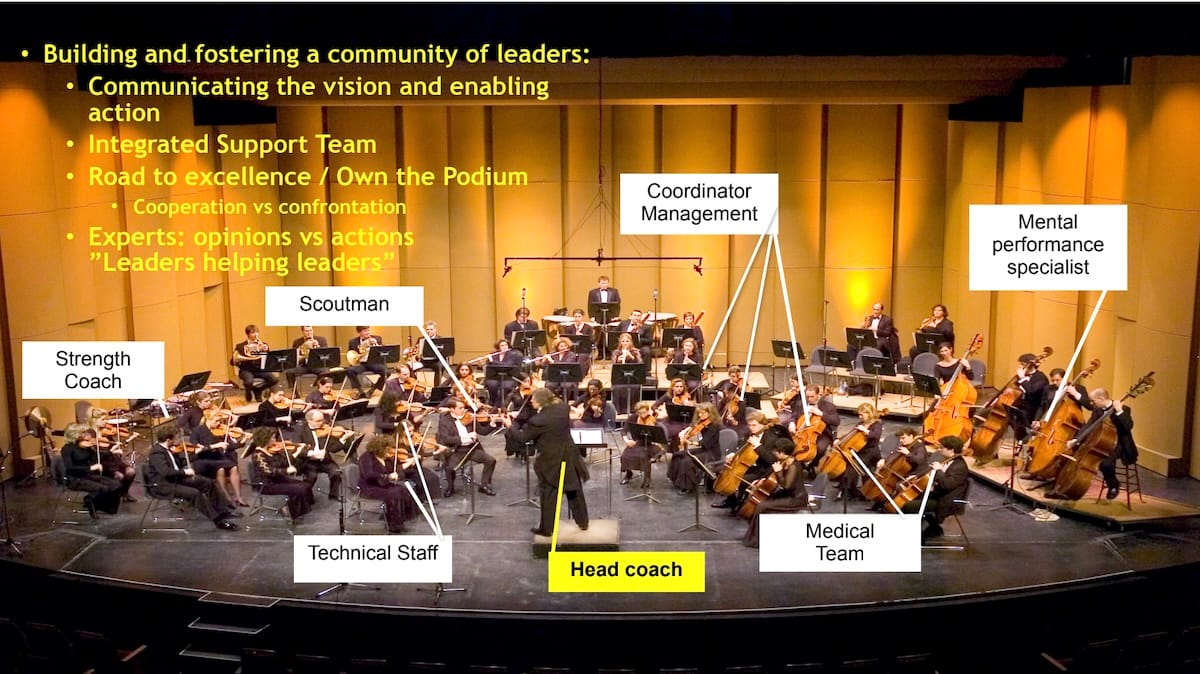
Glenn: Charles (Cardinal) always said the coach is the architect, the headmaster, the one trying to create harmony. Trying to get the team to have flow and to be better. The better we worked together as a group and enhanced our music, the better we would perform on the court.
And for Charles, it was really important that it had to be coach led.
Because the problem with expertise is that everybody likes a little more room. I'm the strength coach, so this is more important. Or I'm the mental performance specialist, so this is more important. You need to create a balance.
That's why the coach has to have his own view of what he wants, and then integrate the people.
Especially with strength coaching. In volleyball now, we have more strength coaches who are familiar with the sport. But back then, a lot of strength coaches came to us directly from university, or from track and field, or from rugby and sports like that.
I remember having one early on for whom everything was about being in top shape. If you're in top shape, you're going to win volleyball matches. It took me a while to change that, and the guys were getting alarmed. They were doing two hour sessions in the weight room in the morning, and then they had about forty five minutes of quality in the volleyball gym at night. They just couldn't do it.
So we needed to change that. We needed to convince that person: listen, we need volleyball players first. Take two people with the same genetics, the same size, the same everything. Put one in the weight room and the other in the volleyball gym. Who's going to win the volleyball game? We know that too well.
Their performance as specialists is really important. So we needed to get everybody, what we call the integrated support team, to work together towards the same goal and to fit in the right places.
I'm a level four coach in Canada. At level four and five, you have twenty tasks you have to learn. One task, for example, is only strength training. You spend time with the strength coach and you prepare a one year strength and development plan for one athlete. I had a really good teacher then. He told me that in the end, you need the right dose for the sport. So I might put some hypertrophy in there. "Not too much, Glenn." It has to go towards strength and speed. Those were the teachings.
Some tasks are on mental performance, and so on.
Basically, they're for the coach to understand. Not to be an expert, but to understand, so that when you work with these people, you speak the same language.
Charles saw it that way, and I thought it was a neat picture. When we started, the harmony wasn't so good. As we got better and created better harmony, our orchestra played better. We beat Brazil for the first time. We started playing with big teams, competing with big teams, and finally we qualified.
So cooperation versus confrontation, that's very, very important. Not having confrontation with the specialists, but making sure they know where they fit within the structure of what we're trying to run. That's why it's important to make them understand: this is the plan, this is what the plan is about, and this is the reality of the plan. So this is where you fit.
We had some discussions, but most of the time, the staff groups I had were very responsive and adapted well to what we wanted. And I learned a lot from them. I'm really grateful for the time I had with my strength coaches, my mental performance specialists and the others. It enhanced my coaching as well. That was nice.
Matias: What resonated with me was the symphony part, of course. But also "leaders helping leaders." You can be an expert in something, but you have to recognise the expertise outside of your own. I think that's a really big one.
Glenn: That's right. And often they would learn a lot. You could see their evolution, how they adapted and changed. From the strength coaching perspective, there's not a lot out there on volleyball. There are a few experts in the world, and often they don't share their work.
But we were able to develop some nice expertise with our strength coaches and our mental performance coach.
The medical staff was the same. I remember having a physio who came from hockey. He had to learn all about volleyball: shoulders, backs. We're actually a sport where a lot of body parts get injured, from the top down. It wasn't easy for him, and it took years, but he did develop real expertise in volleyball specifically.
Charles Cardinal was one of the great builders of Canadian volleyball. He co-founded the Fédération de Volleyball du Québec in 1967 and became its first Technical Director. He coached the Canadian men's national team, served as Vice President of Volleyball Canada, and chaired its national team committee. As a Master Coach and FIVB course conductor, he trained coaches across Canada and abroad, and co-authored most of Volleyball Canada's coaching manuals, the same system Glenn trained in. He ran volleyball competition at the 1976 Montreal Olympics and was an early architect of Canada's Long Term Athlete Development model. [Read his full Hall of Fame profile.]
Glenn: We went through a long period of difficulty, where I had to build the base back up. We had Dan and Fred and Steve Brinkman, a couple of older guys, but then we had a bunch of young guys that we were exposing.
We needed to get there, but it took us a good five years before we started getting some kind of response. Before we started having a higher level of execution.
We beat Serbia in 2010. That was at the World Championship, at the beginning of that growth period. I said to the guys, we're not going to make mistakes. We were already out of the competition. We had lost to Germany, we had lost to Poland. We had played somewhat well, but we just weren't strong enough to beat them. And then we played Serbia and we won three sets to one.
From the perspective of the funding providers in Canada, that was a key moment. We came out of it with a little more money, because we had beaten one of the top teams in the world. That really helped us, because we needed it. Then, the year after, we qualified for World League.
Those were key moments where you could see the program slowly shifting in a positive direction. Eventually the group matured. It took five years.
We couldn't quite make it for London. We lost to the US at home. We had beaten Cuba and we were in the NORCECA final, but the US beat us and we didn't go to the Olympics.
But there were signs there. There were signs data wise, and the data is the most important thing, because it tells you so much about what you still need to work on. I think the group was also starting to believe more in themselves.
We kept improving our play until we qualified for Rio. It wasn't easy. It was pretty tough, actually. But I think we had the level of maturity in Japan to qualify, and that was important.
Glenn: There were injuries. I remember we lost Gavin at some key moments. He had stress fractures in his legs, and he ended up with a titanium rod in one leg, and then a titanium rod in the other.
During this period, at the first qualifier in January 2016, we lost to Cuba. Gavin's injury just threw us off, and we just weren't ready. I didn't prepare the team properly for that moment. So we ended up going to Japan, into a much harder environment: eight teams, all trying to qualify through that tournament. Gavin came back just in time, and he brought us through to qualification.
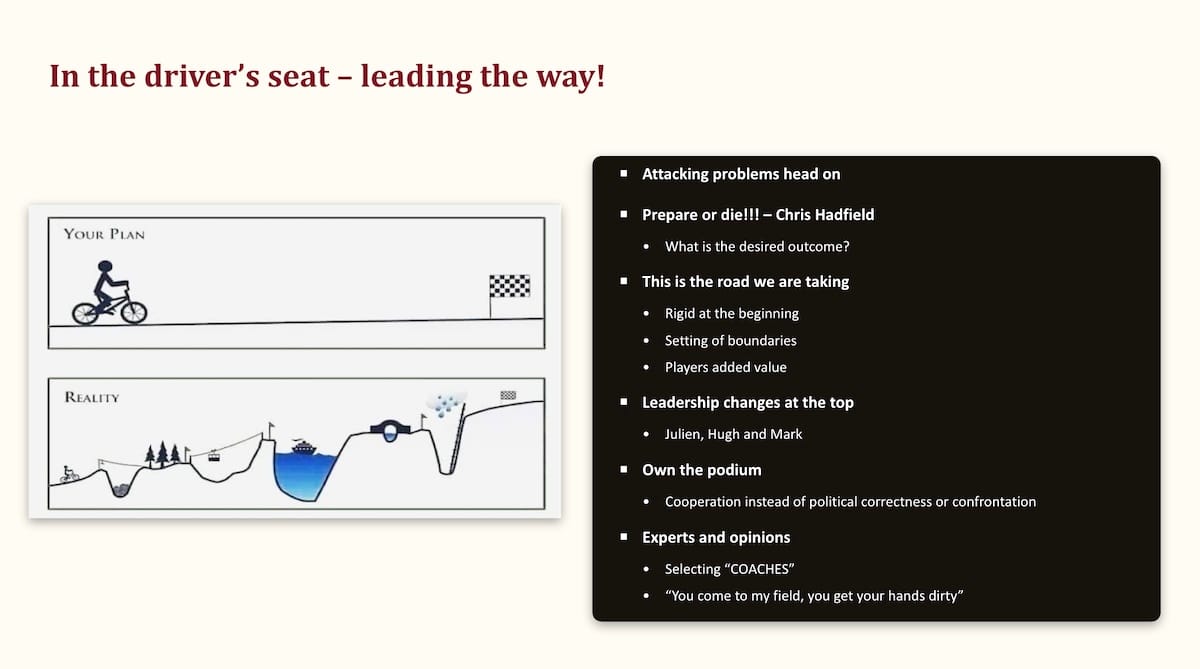
It was full of ups and downs, which is normal. I think I have a slide with that: my plan, next to the reality. The plan is a nice straight line.
And the reality is that it's pretty chaotic. I think it's the same for every coach in those moments. We all wish our plan would be a nice straight road, with no bumps.
Matias: With no bumps. Just slightly uphill, at a small angle. And a nice bike with inflated tires.
Glenn: Just a little bit of effort. I think I found this on LinkedIn somewhere, and I thought it was quite nice, quite appropriate. I use it a lot when I do seminars with coaches.
Chris Hadfield is a Canadian astronaut who flew three space missions, was the first Canadian to walk in space, and later commanded the International Space Station. In his book An Astronaut's Guide to Life on Earth, he explains how astronauts handle fear: by preparing relentlessly for everything they can control.
Glenn: This one comes from Chris Hadfield, from his book, I think. Kyle Paquette, our mental coach, brought it to us. He made us realize what stress really was, and how it relates to the outcome.
He told us the story of Chris Hadfield saying: well, the outcome could be that I die. But I can't control that. My rocket might explode. What I can control are the five hundred different buttons and procedures that I have to know and be ready for. And I have to trust my training.
I thought that was a really nice way of putting it. I have a desired outcome, and I don't want it to be negative.
The problem is that I don't control the outcome. I do control the process.
We all know that, right? But knowing that one possible outcome is that you die because the rocket explodes, and that you don't control that, puts it in perspective.
I also talked about rigidity at the beginning. I made the program very rigid. Maybe I was wrong then, I don't know. But it was: here's where I want to go, and here's how we're going to do it, systems and so on.
Then, as we went, we found players who added value. For example, TJ and Nick, and Van Burkel, the middle. They all came in from our junior program. We started having a flow of players coming in who could help the team, instead of just the initial group, which was the older guys plus a few young ones. After five or six years, we had added players who could add value. But we needed to develop them to do that.
They didn't just appear. It was all part of the same plan.
I don't want to talk too much about the leadership at the top, but I do remember that we went through a really bad financial period in the early years. All the money got taken away, until we beat Serbia. I had to leave my family and go work in Slovenia for two years, because we were so short on money. I said, don't pay my salary, and then we'll have some money for the program.
Then Mark Eckert, the president, came in. I remember being in a hotel, and he said, "Do you want to be in World League next year?" I didn't believe it. I said, "You guys can't get us into World League." He said, "Just win the games, and I'll find the money." It wasn't easy. We had to beat Slovakia and Puerto Rico, I think in 2011. But that brought a big inflow of money, and we could play at a high level and, again, have data.
When I first came, the funding program wasn't called Own the Podium yet. I think it was called Road to Excellence. They had given us money, but there were benchmarks, and the benchmarks weren't met. So they came to me and said, "The benchmarks weren't met, we're taking the money away." I had no idea. I didn't even know who these people were. I'd only been there for a year, and suddenly we had no money.
So when Own the Podium came, I had a certain mistrust. But what I did was educate them.
I helped them understand what my sport was all about. It's not a sport where you can measure distances or times. It's a very random sport.
So we explained: here are the performance indicators, here are some of the levels. If we can reach these levels, then maybe we can start competing with the rest of the world. They got on board with that and gave us money and support, including support from the integrated support team, who suggested some things. That was very, very good.
The last two points are really important: selecting coaches to help with our youth programs. In the university sector, it's very much about recruiting. If you want to be successful, especially in Canada, the schools that are the best recruiters will always be on top. But when I go to the international game, I'm not recruiting anymore. I have to develop athletes to get to that level. That's a very different thing.
So at that point, I started looking at schools that were successful with athletes who weren't so strong, who were average. I brought in some of those coaches, who were used to working hard at developing. And that's the last quote: if you come to my field, you get your hands dirty. Whether you're a junior coach or the Canada B team coach, we're going to work really hard at clearing the field of rocks, and then building it the way we did, together.
And again, for me, it's about creating urgency.
Every practice, we need to move forward. We cannot be complacent at any time.
That complacency has been a bit more present in the last few years, because as success came, the agents came. More and more university guys go overseas very early. So they don't go through the same process of development and of becoming real, strong warriors.
We get more players who go overseas and come back, and we're not necessarily controlling the coaching they're getting. I think that's a reality of our success, after qualifying for three Olympics. The program created its own success, and at the same time, I think it created its own problems.
Matias: You'll know the quote. I'm going to butcher it if I try to say it. It's the "hard times create hard men" thing.

Glenn: Yes. I don't know if you know Nassim Taleb, the philosopher, and his book Antifragile. It's funny, because my mother in law, who has passed away, had a hard life when she was young. She was Slovenian and immigrated to Canada in 1957. She had to run through the mountains, holding her three year old son in her arms. She had to beg. She went through so much, the Nazi occupation and all that. Taleb calls these people robust.
They're robust people, and she was a robust lady. She was really, really small, but tough as nails. Because of the difficulties she had to deal with in life, she developed robustness.
And I really enjoy athletes who are robust. Athletes who can come in and go through the pain.
Gavin Schmitt is a great example, with two rods in his legs. He was in a lot of pain when we had to qualify in Tokyo, and we went through all of that together. So when you talk about robustness, his story is pretty amazing.
Matias: What is Gavin doing now? I'm always curious about what happens after.
Glenn: He's good. I think he's in Regina. Saskatoon or Regina, I don't remember. Anyway, I think he's working with the Wheat Board of Canada, and doing really well. He has a family now, two little boys. Well, they're not so little anymore.
Matias: Giants, two little giants.
Glenn: Yes, exactly. I get to message with him once in a while. He's doing really well, so I'm happy for him.
Matias: As a coach, and especially for someone like you who's into continuous development, isn't it interesting to see what your players get into afterwards? For them, it's a kind of rebirth. You're thirty five, thirty six, thirty seven, and now you have to figure it out.
Glenn: Yes, it's very interesting. A lot of them write back and ask me, "I'm going to become a firefighter, I'm going to do this. Can you send me a letter of recommendation?" And I would. Then the city would phone me back and ask me about this player or that player. It was fun to have that chance. They gave me so much, so I could give something back.
I could tell their story to someone else: if you hire this guy, you're going to be in good hands, because he went through a lot.
I really enjoy hearing about how they're doing, and I think most of them are doing really, really well.
Matias: It's so obvious to ask your former national team coach for a recommendation, if you've been in the program for six, seven, eight or ten years. I would never have thought of doing that, but it's so obvious.
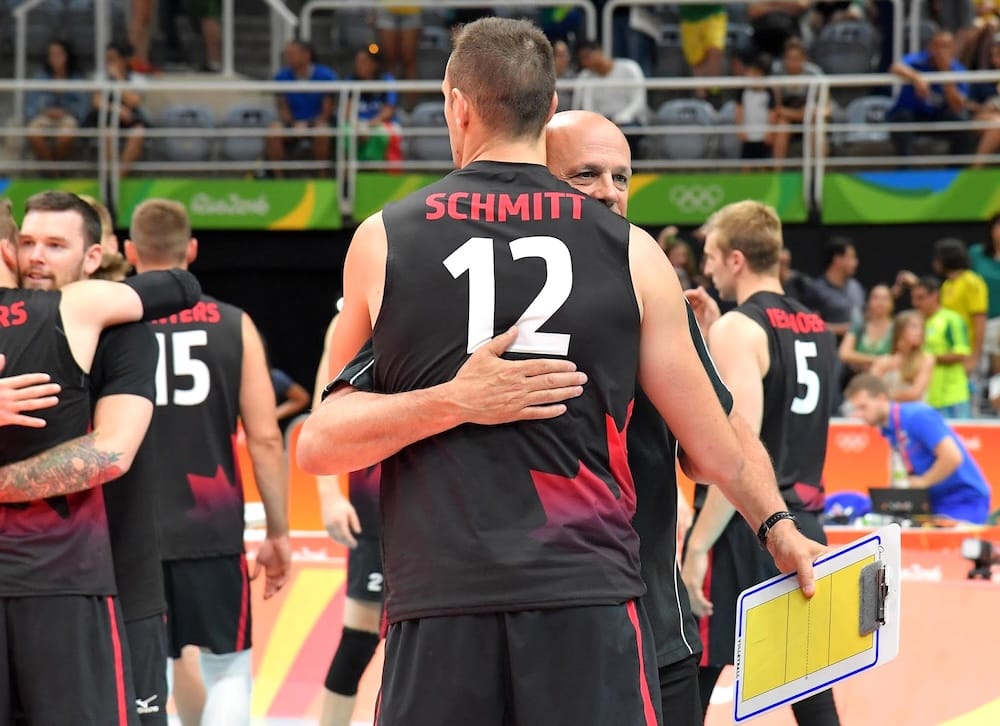
Glenn: Yes, because you know part of their story, and the story they had with you. The grind. Watching Gavin go through surgery and then recover in time to play in Japan. He had four months. He was running on an underwater treadmill in Vancouver to try to get back for the qualifier. Or TJ Sanders, who struggled with back issues, pretty severe ones actually.
You can tell stories about all of them, and how they worked through these things to give the team their best, given their condition. Most of those stories are real, and they'll benefit whoever hires them, whatever the job.
Because they've got that robustness. They developed it by going through really, really hard times.
And I think that forms people.
Thank you, Glenn.